Get Full Government Meeting Transcripts, Videos, & Alerts Forever!
Get email alerts on the Seclusion Timeline And Report topic
No spam. Unsubscribe anytime.
Seclusion working group adopts 10-year runway; final report approved after 6–5 votes
Summary
On Jan. 28, 2026 the Seclusion Working Group voted 6–5 to adopt a Mace proposal permitting limited seclusion for students in Setting 3/4 through July 1, 2036, and approved its final report to the legislature by the same margin amid sharp disagreement over grades 1–3.
The Seclusion Working Group voted 6–5 on Jan. 28, 2026 to adopt a timeline proposal from Mace that permits limited use of seclusion for students receiving Setting 3 or Setting 4 special education services, with a termination (sunset) date of July 1, 2036, and a requirement that the Minnesota Department of Education (MDE) collect and study data related to reductions or eliminations of seclusion.
The vote came shortly before the group also approved its final report to the Minnesota Legislature by the same 6–5 margin. The meetings and votes concluded the working group established by statute to review the use of seclusion in K–12 settings; the group expires by statute on Jan. 31, 2026 and its report to legislative committee chairs and ranking members was due Jan. 30, 2026.
Why it matters: The group’s action replaces an earlier 2023 restriction that banned seclusion from birth through grade 3 (effective Sept. 1, 2024) with a compromise timeline in which limited seclusion could remain permitted for some special-education settings through 2036, contingent on additional safeguards and MDE data collection. The decision was contested: members who supported the motion framed it as a pragmatic way to give districts time and resources to implement alternatives, while opponents said they would not support walking back protections adopted in 2023.
What the working group debated and voted on
Chair Senator Seaburger, who led the meeting, recapped the statutory background and said he had introduced Senate File 1830 (SF 1830) after stakeholders and activists did not engage in earlier negotiations. "I voted yes on that bill without knowing this was in the bill," Seaburger said of the 2023 omnibus measure, criticizing omnibus voting procedures. He described amendment '007-7' to SF 1830 as an attempt to restore limited seclusion with additional safeguards.
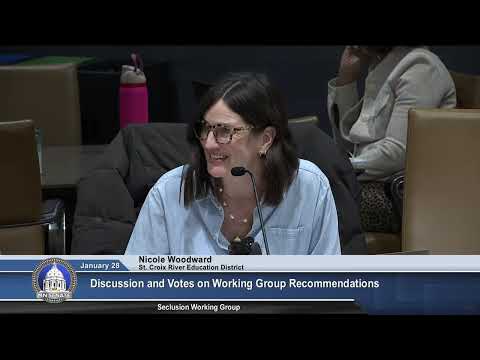
Miss Woodward, speaking for the Mace submission, said Mace sought a middle ground and proposed a July 1, 2036 sunset to give districts a 10-year runway. "We are really trying to meet in the middle," Woodward said, adding that the timeline would only be feasible if legislation included appropriations to help districts implement alternatives such as space enhancements, training and staffing.
A protection-and-advocacy representative opposed rolling back the 2023 ban. "I cannot vote for anything that walks back the current ban," the representative said, adding that the position reflected casework and data received by her office.
Chair Seaburger moved to adopt Mace’s proposal with one technical edit — substituting "MDE" for a drafting error — and requested a roll-call vote. The roll call recorded the following votes on the timeline motion: Seaburger (yes); Senator Coleman (yes); Dave Habman (yes); Kate Holes (yes); Greta Chose (yes); Nicole Woodward (yes); Representative Censor Murrah (no); Jessica Heizer (no); Fatima Molis (no); Erin Sandzmark (no); Melissa Winship (no). The chair announced the motion passed, 6–5.
The group then voted by roll call to approve its final report to the legislature, authorizing Legislative Coordinating Commission (LCC) staff to prepare the report and incorporate the recommendations adopted at the meeting; that motion also passed 6–5.
Points of contention and next steps
Members disagreed chiefly over whether the 2023 ban on seclusion for birth through grade 3 should be modified. Seaburger and supporters argued that, in some districts, the absence of seclusion has led to more physical holds and injuries and that limited, well‑regulated seclusion remains a necessary emergency tool for some students. "The activists also disregard the data, which shows that in the absence of seclusion, physical holds have increased dramatically as have injuries to staff and students," Seaburger said.
Opponents and advocacy representatives rejected reopening the ban. A protection-and-advocacy representative said her office has consistently sought elimination of seclusion and restraint, and that her objections were grounded in research and constituent reports.
Several members requested that the final report explicitly distinguish recommendations adopted by consensus from those adopted by roll-call vote; the chair agreed to note the different processes in the report. Staff summarized recent, limited edits to the draft report (an overview of process and a record of finalized recommendations from Jan. 14 and Jan. 20 meetings) and were authorized to finalize technical changes.
Votes at a glance
- Motion to adopt Mace proposal (with edit substituting MDE): Passed 6–5 (Yes: Seaburger; Senator Coleman; Dave Habman; Kate Holes; Greta Chose; Nicole Woodward. No: Representative Censor Murrah; Jessica Heizer; Fatima Molis; Erin Sandzmark; Melissa Winship).
- Motion to approve final report and authorize staff to prepare it for the legislature: Passed 6–5 (same margin).
What the record leaves unresolved
The working group completed its statutory mandate and the final report will be forwarded to legislative committee leaders. Members disagreed publicly about the merits of restoring limited seclusion for grades 1–3 and about whether the available alternatives (for example, interventions referenced in discussion such as MTSS, PBIS, PCM, and programs members called "Yukero") are sufficiently vetted. Several members emphasized that any timeline would need dedicated appropriations to support districts in implementing alternatives.
The working group expires Jan. 31, 2026; the report is due to legislative committee leaders and ranking minority members on Jan. 30, 2026. Chair Seaburger said he will continue to gather data and discuss next steps with legislative chairs.