Get Full Government Meeting Transcripts, Videos, & Alerts Forever!
Get email alerts on the Committee Votes Roundup topic
No spam. Unsubscribe anytime.
Committee advances three bills in work session: school nutrition, emergency‑alert localization and targeted college‑readiness funding
Summary
After public testimony and work sessions, the committee moved LD 2017 (school nutrition updates) 'ought to pass as amended' with an 8–3 recorded vote; LD 2003 (localize emergency broadcast messaging) was ordered 'ought to pass as amended' (amendment removed emergency preamble); LD 2147 (one‑time funds to support college‑readiness in certain counties) was moved 'ought to pass as amended' with fiscal amendment.
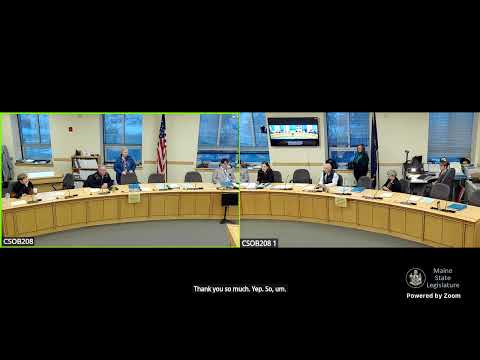
The Joint Standing Committee on Education and Cultural Affairs completed work sessions and took formal committee action on multiple bills during the recorded session.
LD 2017 — school nutrition updates (motion: ought to pass as amended) Representative Dodge moved that LD 2017 "ought to pass as amended." Committee staff and Department of Education witnesses explained the bill would change several statutory mandates related to school meal applications (for example changing a "shall" to "may" for the Department’s online application), remove requirements the Department can no longer fulfill, and preserve the subchapter on food rights through a friendly amendment. The Department reported the current state contract for the online application is $250,000 per school year and that 38 school administrative units currently use the state provider. Outcome: Committee motion carried as recorded in the work session; the clerk recorded a vote of 8 in favor and 3 opposed and a minority report filed as "Not to Pass." (Committee directed staff to record the committee report per standard practice.)
LD 2003 — localization of emergency broadcast messaging (motion: ought to pass as amended) The committee considered a $600,000 one‑time appropriation to fund encoder hardware at transmitters to permit geographically targeted emergency messages over the statewide radio distribution network (the statewide distribution is the backbone for EAS messages in Maine). Maine Public Broadcasting representatives explained the technology and described how localization reduces irrelevant statewide alerts and allows targeted warnings during localized disasters. Representative Brandon moved "ought to pass as amended" with a sponsor amendment removing the emergency preamble so the appropriation would be for FY27 rather than immediate emergency funding. The committee approved the motion as amended. Outcome: Motion carried as amended; committee recorded passage in work session (vote tally not specified on the record provided).
LD 2147 — funding for college and career readiness in Androscoggin and Oxford Counties (motion: ought to pass as amended) LD 2147 proposed one‑time funds (approx. $309,000 FY27) for the University of Maine System to support services to students who previously participated in a River Valley Upward Bound program after federal non‑continuation. Committee analysts explained the intent is to bridge a gap after federal funds were not renewed; the University described the program’s intensity and argued one‑time funds would be used to target affected students while the system pursues federal remedies and future grants. Representative Dodge moved that LD 2147 "ought to pass as amended" with the fiscal note amendment; the committee approved the motion. Outcome: Motion carried as amended (vote tally not recorded on the transcript excerpt).
Context and next steps For LD 2017, the Department of Education testified that repealing statutory collection requirements was driven by the state’s move to universal school meals and the proliferation of Community Eligibility Provision (CEP) participation, which reduced the utility of individual meal application data. Committee members requested the fiscal note that would document the $250,000 contract savings and any subsequent effect on the department’s budget.
For LD 2003, witnesses stressed the investment is in transmission hardware to enable more targeted public safety alerts; they said the appropriation would not fund programming or PBS content and would not flow to programming budgets. For LD 2147, the committee asked for reporting and for the university to coordinate outcomes and to seek federal remedies where appropriate.
The committee recorded minority reports where indicated and directed staff to prepare committee reports and draft letters to accompany the work session recommendations.