Get Full Government Meeting Transcripts, Videos, & Alerts Forever!
Get email alerts on the LD2099 Aspirations topic
No spam. Unsubscribe anytime.
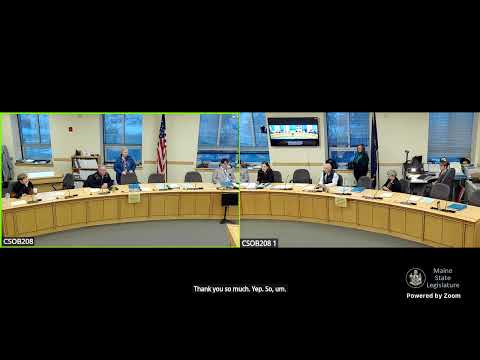
Maine committee hears hours of testimony on LD 2099; debate centers on 18‑credit cap for Aspirations early college program
Summary
Representatives, higher‑education leaders and school advocates debated LD 2099, which would clarify Aspirations Program rules and introduce an 18‑credit lifetime cap (plus 6 credits for CTE). Supporters say the cap maintains sustainability under current funding; opponents warn it would harm rural and high‑participation students and urge increased appropriations.
The Joint Standing Committee on Education and Cultural Affairs heard extensive testimony on LD 2099, a bill that updates eligibility and program administration for Maine’s Aspirations early college program and proposes a lifetime limit on state‑funded credits.
Representative Holly Sargent, sponsor of LD 2099, told the committee the draft is largely a technical cleanup to align the Aspirations Program statute with current institutional calendars and administrative practice, and that the amendment in members’ packets includes a limited change to define the academic year and add a lifetime credit cap with CTE exceptions.
"This bill makes critical updates that reflect months of work among our three players," Sargent said, referring to the Department of Education, the University of Maine System and the Maine Community College System.
What the bill would do: Dr. Laura Cyr of the Maine Department of Education outlined changes the bill would make, including clarifying the academic year (summer, fall, spring), requiring schools to record Aspiration‑funded coursework on student transcripts (not mandating course acceptance for diplomas), simplifying enrollment language, and introducing a proposed lifetime cap of 18 state‑funded credits with up to six additional credits allowed for students in designated CTE programs. Dr. Cyr said the cap is intended to sustain access given constrained program appropriations and that institutions retain final authority to determine individual enrollment.
Supporters’ case: Mercedes Poor, director of college access for the Maine Community College System, told the committee the Aspirations statute has become the scaffold for statewide early college collaboration and that revisions will update the law for modern delivery (including online concurrent enrollment). Sam Warren of the University of Maine System said Maine’s early college participation doubled over the past decade and noted that the current $5.5 million appropriation falls short of demand. "Our system's preference is that you increase appropriation to meet the demand," Warren said, but he also described the 18‑credit cap as a temporary, reasonable step to preserve broad access if appropriation levels do not rise.
Opponents’ case: Eric Waddell, testifying on behalf of school management associations, and other witnesses said an 18‑credit limit would disproportionately affect rural students and those at small schools who rely on Aspirations for access to advanced coursework. Waddell cited local examples where students earned more than 18 credits and warned a cap could entrench inequities. Other testimony (MEA, University staff, parents) emphasized the program’s role in workforce pipelines, lifting first‑generation students, and saving families college costs.
Data and fiscal questions: Committee members repeatedly asked for more detailed, school‑level data showing who would be affected by an 18‑credit cap and what the appropriation shortfall would be; Sam Warren suggested an appropriation closer to $7.5–8.0 million would better match current demand. Several legislators asked for by‑school breakdowns of students at or above the cap for use at work session; witnesses agreed to provide additional data.
Implementation and scope: Dr. Cyr said the 18‑credit cap is not intended to prevent students from enrolling in additional courses, but to limit state‑funded credits; excess credits could be taken at a reduced rate. Committee members pressed on whether institutions agreed to the changes — witnesses testified that the Department, community colleges and UMS had worked together on revisions and that the systems had accepted the priority notice imposing an 18‑credit limit as a way to preserve access.
What comes next: The committee closed public testimony and took LD 2099 to work session scheduling and data requests. Members asked for school‑level distributions of students close to or exceeding the 18‑credit threshold, fiscal comparisons of delivering comparable advanced coursework in high schools versus state‑funded Aspirations credits, and clarity on which credits count as 'Aspirations' under statute. The committee did not take a final vote on LD 2099 during the session recorded in this transcript; members requested additional information ahead of work session deliberations.
Representative Holly Sargent and Department staff provided the bill text and an amendment in redline to committee members; witnesses agreed to provide further data to inform the committee’s work session.
Bottom line: LD 2099 frames a policy choice: constrain state support per student to sustain broad access under a fixed appropriation, or increase appropriation to preserve open access to Aspirations credits. Committee members asked for targeted data to assess distributional impacts across rural and urban districts before deciding whether to recommend policy or fiscal changes.