Get Full Government Meeting Transcripts, Videos, & Alerts Forever!
Get email alerts on the Rideshare Policy topic
No spam. Unsubscribe anytime.
Committee backs study of rideshare data and deactivation practices after stakeholder talks; industry signals willingness to engage
Summary
Lawmakers voted to send LD 877 forward as an amended legislative study to gather TNC data (compensation, deactivation, contracts) and convene a stakeholder group; Uber said it will participate where data sharing is allowable and DOL flagged classification tests and data‑privacy constraints.
The Labor Committee voted to advance LD 877 as an amended legislative study to gather aggregate information on transportation network companies operating in Maine, including compensation, the take rate, deactivation processes and contractual terms.
Representative Ellie Sato, sponsor of the amendment, told the committee she convened a stakeholder meeting with TNCs, drivers and labor representatives and then drafted membership and duties for a study group that would include legislators, driver representatives, a statewide union representative, two TNC representatives, Department of Labor representation and researchers. "The first duty would be to collect aggregate data and information while respecting proprietary needs of TNCs," Sato said, explaining that statutory authority can be required to obtain company data.
Department of Labor legislative director Dylan Murray told the committee Maine uses a test to determine classification and that the department can help design data requests and protect proprietary information; he said the department has a role in compensation analysis. James Cody, representing Uber, said the company is "happy to have those conversations" and would work with the committee or department to the extent data can be shared without violating proprietary constraints.
Why it matters: committee members flagged opacity around deactivation — drivers reported being deactivated after clerical issues such as an upload problem or an expired ID — and expressed concern that drivers might fear retaliation if they testified publicly. Representative Geiger asked whether deactivation data should include safety incidents; Sato said that aggregated deactivation information could surface patterns, including customer assault reports tied to deactivations.
Several members asked whether the department could instead collect baseline data (a registration platform or limited reporting) as a lower‑cost alternative; staff said that approach is feasible and that language can be drafted to limit requests to companies that operate in Maine and to specify guardrails for proprietary data. Committee counsel confirmed legislative studies are staffed by OPLA, meet during the interim and may report recommendations to the committee for legislation.
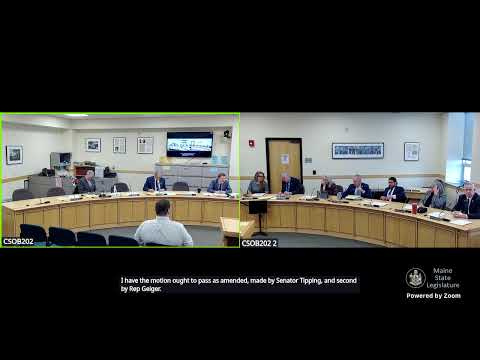
The committee adopted the amendment and voted on the motion to report LD 877 "ought to pass as amended." The roll‑call recorded six votes in favor and four opposed; the minority report recommended "ought not to pass." Opponents cited the absence of public driver testimony at the public hearing and questioned the need for a formal study instead of DOL action.