Get Full Government Meeting Transcripts, Videos, & Alerts Forever!
Get email alerts on the Employment Contracts topic
No spam. Unsubscribe anytime.
Urbana committee pauses standardized employment-agreement resolution after council raises severance, residency and timing concerns
Summary
Committee of the Whole debated a proposal to adopt standardized employment-contract templates for appointed city positions — including severance tiers (up to a 20-week cap), a $10,000 relocation incentive, and transition-of-duty language — and voted to keep the item in committee after straw polls favored removing retroactive accrual, the residency incentive and tightening terms.
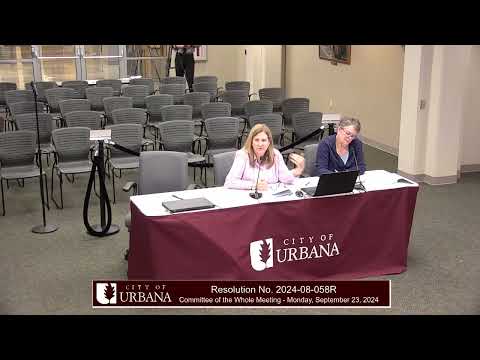
The Urbana Committee of the Whole continued its review of resolution 2024-08-058R on standardized employment agreements for appointed city employees, delaying final action and returning the measure for further drafting. Council members focused on how severance would accrue, whether current appointees would be retroactively credited, and a $10,000 relocation/residency incentive built into the draft.
The template presented would set maximum severance tiers — staff noted the draft used a 20-week maximum consistent with the state maximum — and included optional insertable sections for position-specific terms. Councilmember James urged limiting liability for the city by making severance accrual start at the contract execution date rather than retroactively recognizing past service, saying the current wording could create a “significant liability” if the mayor negotiated agreements for many eligible employees (discussion at the meeting). Staff replied that typical vacancy savings often cover separation costs but acknowledged exceptions exist in senior roles.
Concern about the $10,000 residency/relocation incentive surfaced repeatedly. Councilmember Jaya said the timing of adopting a program with long-term fiscal effects in an election year felt “very uncomfortable,” and questioned whether bonuses that exceed other public compensations were appropriate. Several council members, including Mary Alice and others, suggested replacing a flat residency bonus with ‘‘reasonable relocation expenses’’ capped case-by-case.
Members also asked for clearer legal referencing and enforceable transition-of-duty language. A council member asked staff to cite the relevant city code chapter rather than an imprecise article reference; staff agreed to revise the text to make code references clearer. Legal counsel explained that state law limits total severance to 20 weeks and that certain municipal-code removal provisions could operate as exceptions to severance in some removal scenarios (discussion clarified by counsel).
Rather than forwarding the unchanged resolution to city council, the committee conducted a series of straw polls addressing six proposed adjustments: removing retroactive severance accrual for current employees; removing the residency incentive; reducing the severance maximum to 16 weeks; applying the template only to full-time permanent appointees (excluding interim/limited-term positions); restricting mayoral discretion to bracketed/insertable sections of the template; and asking staff to draft more specific transition-of-duty language. A majority supported these changes. After procedural steps and a clerk’s review, the committee voted to keep the item in the Committee of the Whole for at least one more review cycle so staff could incorporate the guidance and return with revised draft language.
Next steps: staff will revise the template to reflect the committee’s direction — including clearer city-code references, a drafted option for more specific transition-of-duty provisions, and the straw-polled adjustments — and return the draft to Committee of the Whole for further consideration before any vote by the full City Council.