Get Full Government Meeting Transcripts, Videos, & Alerts Forever!
Get email alerts on the Votes Roundup topic
No spam. Unsubscribe anytime.
Votes at a glance: Key measures the Connecticut Senate passed on May 28, 2025
Summary
The Senate approved a package of bills on May 28, 2025, including a bill allowing striking workers limited unemployment benefits, adjustments for nursing‑home quality incentives, purchasing‑card accountability, health workforce recruitment, nonprofit contract indexing, and a battery recycling stewardship program. Most measures passed with recorded roll‑call votes.
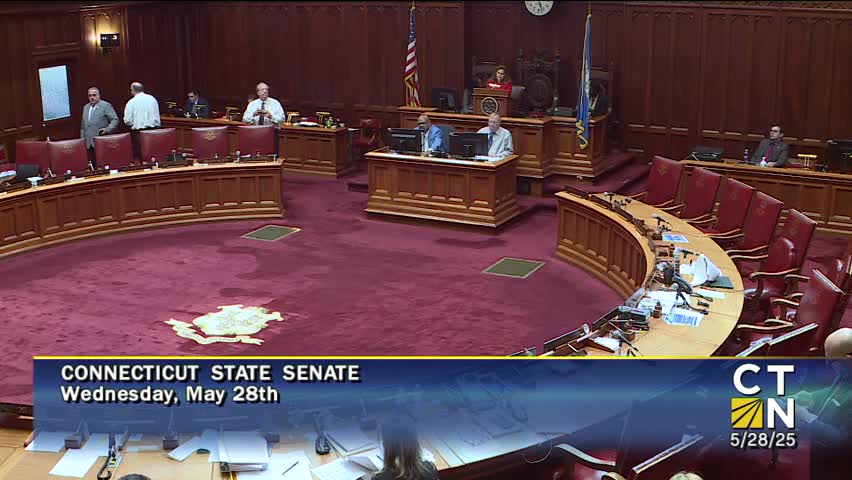
Hartford — Following extended debate on several measures, the Connecticut State Senate recorded final action on a set of bills on May 28, 2025. Highlights and outcomes (Senate action only):
- Senate Bill 8 (as amended): Allows workers engaged in a labor dispute to collect unemployment benefits after 14 consecutive days on strike for disputes starting on or after Dec. 14, 2026. Passed Senate (roll‑call: Yea 24, Nay 11; transmitted to House). (Proponent: Sen. Kushner.)
- Senate Bill 1333: Converts an existing DSS quality‑matrix pilot into a permanent program to reward nursing homes with payments/grants for high quality outcomes; requires public hearings for long‑term care premium increases above 10% and directs studies to expand home‑based care. Passed unanimously (36–0). (Proponent: Sen. Hockadell.)
- Senate Bill 1468: Government accountability act focused on agency purchase‑card use (created purchase‑card coordinator roles, defined limits and approval/reconciliation procedures) — adopted as amended and passed unanimously (36–0). (Proponent: Government Oversight Committee.)
- Senate Bill 1450: Recruitment and retention measures for the health‑care workforce (loan reimbursement, virtual education pilots for nurse aides/EMTs, school health promotion, athletic‑trainer grants); accepted with an amendment and passed (roll‑call reported as 35–0 where recorded). (Proponent: Sen. Marks.)
- Senate Bill 1358: Equitable compensation for state‑contracted nonprofit human‑services providers — Senate adopted a technical amendment delaying certain budgetary implementation and passed the bill. The Senate recorded the final vote; the bill passed. (Proponent: Sen. Lesser.)
- House Bill 5019 (concurrence): Establishes an extended producer responsibility (EPR) stewardship program for consumer batteries (manufacturer/retailer‑run collection and recycling program); no consumer fee expected; passed Senate (35–1). (Proponent: Sen. Lopes.)
Other bills and technical fixes: The Senate also moved dozens of additional items (technical statutory revisions, tribal‑land procedure changes, labor department technical recommendations and other agency bills) and placed several items on consent. Where the transcript recorded roll‑call tallies, those counts are noted above; for some measures the record shows final passage without a detailed per‑member tally in the floor transcript.
What this means: Several bills with budget or implementation implications move to the House or would require executive‑branch implementation and, in some cases, appropriations. Measures with fiscal impact (notably the nonprofit indexing and the nursing‑home program) will be resolved in the normal budget and administrative processes. Several bills were described on the floor as bipartisan or industry‑backed (for example, the battery stewardship measure).
Provenance: Each summary above is anchored to the Senate floor transcript covering May 28, 2025; specific starting and ending transcript segments for each item are listed in the article metadata.