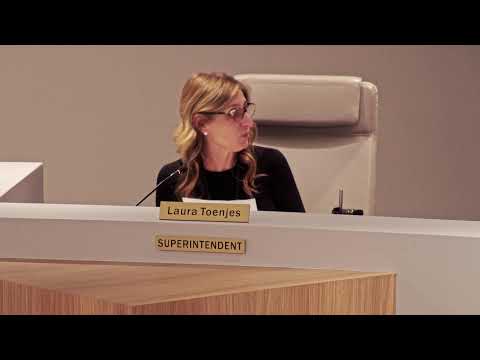
Kyrene board hears governor’s K–12 budget preview; Prop 123, ESA reforms raise questions
Loading...
Summary
Associate Superintendent Chris Herman outlined the governor’s K–12 budget preview, including a proposed 2% inflation increase, one‑time capital assistance, a proposed $1.5 billion bond, and possible Prop 123 renewal and ESA reforms; board members pressed for clarity on retroactivity and student-safety checks.
Mesa — At its regular meeting, the Kyrene Elementary District governing board heard a presentation on the governor’s K–12 budget from Associate Superintendent Chris Herman, who summarized proposals that could affect district revenue and planning.
Herman said the governor’s preview includes a 2% inflation increase for the state base level (listed statewide as $174,000,000), $29,000,000 in one‑time charter capital assistance, and a request to renew Proposition 123 that the presentation estimated could provide about $271,000,000 in additional base aid if approved by voters. He also described a proposed three‑year, $1.5 billion bond to address statewide school facility needs and called out several suggestions for reforming the Empowerment Scholarship Account (ESA) program, including an income cap and tighter allowable‑spending rules.
"A 2% increase in funding is the maximum amount that public schools can receive from the state according to the laws that are in place for public educational funding," Herman said, adding that the governor’s proposal is a starting point for legislative negotiations and not a guarantee of final funding.
Why it matters: Many of the items Herman described — notably a Prop 123 renewal and the proposed bond — would require voter or legislative action and could materially change available revenues in future years. The board will continue to plan conservatively for the FY27 budget because voter referenda or legislative changes may not take effect in time to fund next year’s adopted budget.
Board members pressed for specifics. Member Davis asked whether the governor had proposed alternatives to Prop 123 and sought confirmation about contingency planning if voters reject a renewal: "So it sounds like if it doesn't pass, there's no plan for increased funding for schools," Davis said. Herman replied the governor’s materials did not include substitute funding sources and that any retroactive application of voter-approved measures would depend on the precise referendum and legislative language.
Member Walsh welcomed certain ESA reforms, raising equity concerns about the program’s current distribution: "I am encouraged to see that the governor's proposed things like prohibiting luxury expenses over $500," Walsh said, noting his view that voucher spending has disproportionately favored higher‑income ZIP codes.
On student safety, Herman noted the governor’s materials suggest increased accountability for ESA use, including fingerprint clearance requirements for private‑school staff and tutors. Board members said they were surprised to learn some ESA providers do not currently require fingerprint clearance cards and flagged student‑safety implications.
Herman emphasized timing and uncertainty: any Prop 123 renewal would likely require a November ballot and possibly retroactive language to affect FY27; however, whether such retroactivity would be included is unknown and would depend on the referendum and legislative action.
The board did not take formal action on the governor’s proposals. Herman said the district will bring more detailed budget items to spring study sessions and that formal budget votes are expected in June (proposed) and July (adopted) on the district timeline.
Next steps: District staff will continue operational budget development, monitor legislative activity, and return with sharper enrollment and revenue projections at upcoming study sessions.