U.N. envoy urges scale‑up of humanitarian access and reconstruction support for Gaza
Loading...
Summary
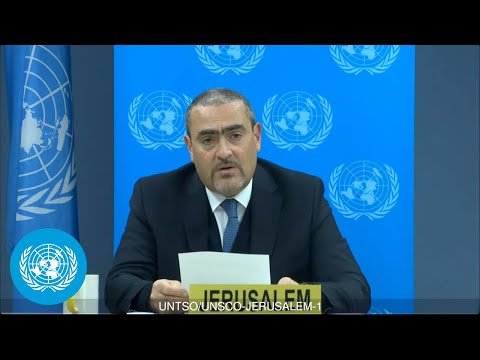
At a Security Council briefing, Rameez Rameez Alakbarov urged swift, coordinated action to expand humanitarian access to Gaza, citing shelter shortfalls, severe weather impacts on more than 1.5 million displaced people, and that only a fraction of aid has moved through regional corridors.
Rameez Rameez Alakbarov told the Security Council that Gaza faces "both profound opportunity and considerable risk" as the second phase of the ceasefire plan begins and new administrative bodies are formed.
He said the United Nations "stands ready to support the committee and the Palestinians in Gaza as they start the arduous work of the building," and urged that implementation move forward in good faith to enable reconstruction and public services.
Alakbarov described widespread humanitarian needs across Gaza, saying "nearly the entire population in Gaza remains in need of humanitarian assistance" and that heavy rainfall and cold weather have worsened conditions for more than 1,500,000 displaced Palestinians. He recounted scenes of families struggling to hold down tents and a young child carrying stones to stop a shelter from blowing away.
The envoy said shelter responses have been hampered by restrictions on entry of vital materials and technical expertise, and that transitional shelter sites "do not meet the scale of the needs or international standards." He emphasized shelters must be voluntary, dignified and in line with humanitarian principles.
Pointing to logistics constraints, Alakbarov said humanitarian actors are "still unable to operate at scale" because of insecurity, customs clearance challenges, a limited number of partners authorized to bring cargo into Gaza, delays and denials at crossings, and restricted transport routes inside Gaza. "Fully utilizing existing proven regional corridors remains essential to saving lives in Gaza," he said, and added that, according to his statement, since October only "9%" of aid has entered Gaza via the Jordan corridor.
He urged that materials enter "at scale"—including mobile homes, rescue equipment, fuel and medical supplies—and noted that aid arriving via Egypt, Jordan, Israel, the occupied West Bank and Cyprus has helped but that "more needs to be done" to meet needs and improve nutrition.
Alakbarov concluded by calling for coordinated support for the National Committee for the Administration of Gaza and related bodies so reconstruction can proceed alongside humanitarian assistance, and asked the council to sustain collective engagement to enable safe, large‑scale aid delivery.