Get Full Government Meeting Transcripts, Videos, & Alerts Forever!
Get email alerts on the Pedestrian Safety topic
No spam. Unsubscribe anytime.
Fayetteville police review string of pedestrian collisions, committee weighs safety fixes
Summary
Police briefed the Active Transportation Advisory Committee on multiple recent pedestrian and bicycle collisions, including hit-and-run and school-crossing incidents. Committee members pressed staff on sight lines, signal timing, geofenced scooter slow zones and portable in-street signage for crossing guards.
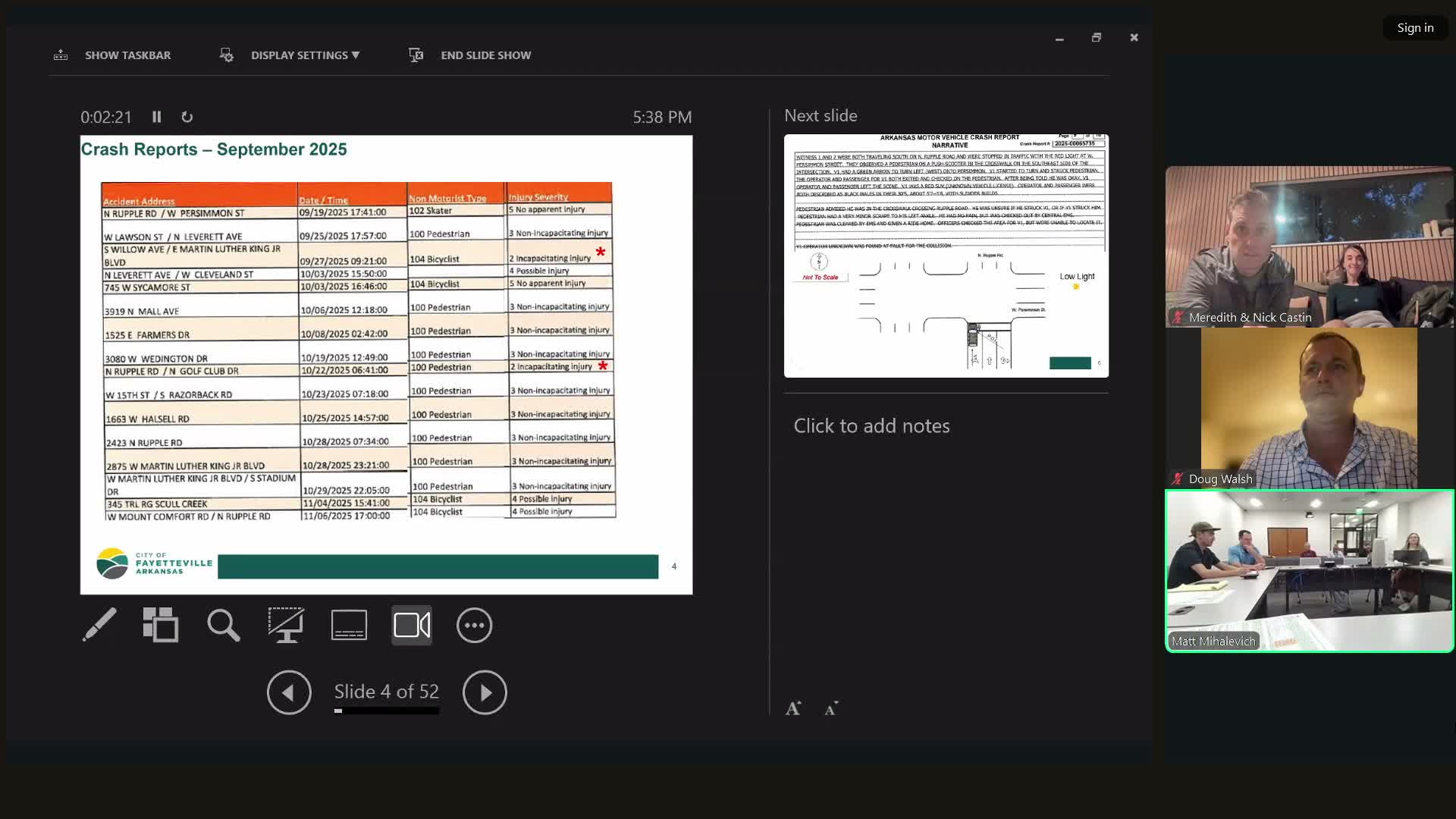
Police and committee members told the Fayetteville Active Transportation Advisory Committee on Nov. 12 that the city has seen a series of pedestrian-involved crashes in the past month, prompting renewed attention to sight lines, signal timing and micro‑mobility controls.
Devin Norris summarized several incidents, including a scooter rider struck at Rupa and Persimmon where the striking vehicle initially left the scene and was later found at fault; a collision at Lawson and Leverett in which a pedestrian who walked behind an articulated transit vehicle was transported to Arkansas Children’s Hospital; and a bicycle struck on Martin Luther King Boulevard after a northbound vehicle failed to yield. Norris also described parking-lot and game‑day collisions and a recent incident in which a student was struck in a crosswalk while a crossing guard was present.
Captain Miller said he had not yet completed investigations on some collisions and would follow up with more detailed reports. “I didn’t get the opportunity to research this accident specifically, unfortunately,” he said, noting officers would review videos and case reports to determine contributing factors and potential enforcement options.
Committee members raised engineering and enforcement questions. Staff described tradeoffs in pedestrian detection placement and signal timing after a Sycamore crosswalk crash, explaining that detectors are sometimes positioned to pick up people on nearby sidewalks or trails and that moving detection farther back can make pedestrians invisible to the sensor. On the relationship with private scooter firms, staff said scooters operate under a city ordinance rather than a contractual permit and that the city can set geofenced slow zones and parking limits; the committee discussed adding slow zones at tight corners and using geofencing to enforce reduced speeds.
Members also discussed hit‑and‑run challenges. According to police, locating a vehicle is easier with a plate number, but proving who was driving at the time can be more difficult; officers said warrants or tickets can be pursued when evidence identifies a driver. For a student struck in a marked crosswalk, staff said the student was evaluated by the school nurse and returned to class and that the committee should consider portable, in-street signage to increase driver compliance during crossing guard duty.
The committee asked staff to follow up with more detailed crash reports, to check signal phasing in high‑pedestrian areas such as Razorback Road, and to explore slow‑zone geofencing and portable crossing signage. Police promised to research outstanding incidents and report back to the committee.