
League flags WUI map, HB215 changes as fees and building-code triggers evolve
Get AI-powered insights, summaries, and transcripts
Subscribe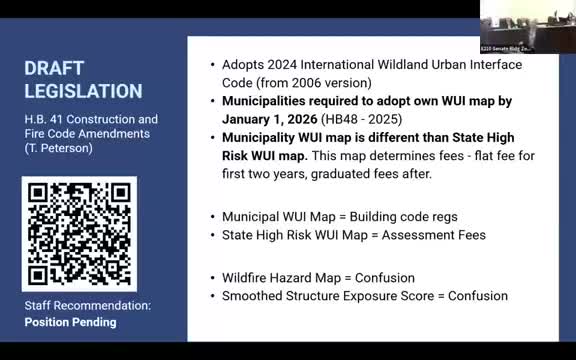
Summary
League legal director Jared Tingay told the Legislative Policy Committee that HB41 would adopt the 2024 WUI standard and require municipal WUI maps; HB215 would limit local vegetation ordinances but include a defensible-space carve-out. Cities raised concerns about fee exposure, appeals and structural hazards.
The Utah League of Cities and Towns told members that two early-session bills would reshape how wildland-urban interface risks are mapped and regulated, with possible fee and building-code consequences for homeowners.
"What the municipalities were required to adopt a WUI map for their city by 01/01/2026," Jared Tingay, the League's legal director, told the Legislative Policy Committee. He said the bill now under negotiation would adopt the 2024 International Wildland-Urban Interface standard and distinguish municipal WUI maps—used to trigger building-code regulations—from a separate state "high-risk" WUI map intended to determine fee assessments.
Why it matters: the bills would change when building-code requirements apply and could expose properties to a state assessment tied to the high-risk map. Tingay described the draft proposal as requiring municipal WUI maps to treat an exposure score of "5 and above" as within the WUI, while leaving appeals and fee calculations tied to separate state layers.
League staff said the current appeal pathway is cumbersome and they will press negotiators to make it easier for local fire chiefs to request corrections when local topography or conditions differ from statewide maps. "There is a current appeal process in the code... that is going to be part of the discussions," Tingay said.
The session also covered HB215, a bill that would restrict some municipal ordinances that limit private vegetation removal. Tingay said the negotiated change would preserve a narrow exemption: residents may remove vegetation to create defensible space to reduce fire risk. "If a resident wants to tear out their tree because it's too close to their home and they want to be able to make a defensible space, they'll be able to do that," Tingay said.
Local officials pressed broader concerns about risk beyond vegetation. "My concern is... it's the structures that are going to be the problem," said Jared Mark Christiansen (Saratoga), citing sheds and RVs placed near the urban interface that can allow fire to jump into houses. League staff said those points are part of the ongoing negotiation.
Next steps: League negotiators plan Slido polling follow-ups with members and will continue talks with bill sponsors about appeal processes, fee design and technical clarifications. The League has not reported a final position pending those negotiations.