Get Full Government Meeting Transcripts, Videos, & Alerts Forever!
Get email alerts on the Elections topic
No spam. Unsubscribe anytime.
Senate approves emergency bill to exclude Easter from early voting window and waive certain MRSA limits
Summary
The Connecticut Senate passed an emergency-certified bill removing Easter Sunday (04/20/2025) from the early-voting window for a special election and temporarily exempting specified municipal spending from the municipal revenue sharing account (MRSA) cap for the 2025–26 fiscal year. Supporters framed it as a time-sensitive operational fix; critics said a permanent fix should go through committee.
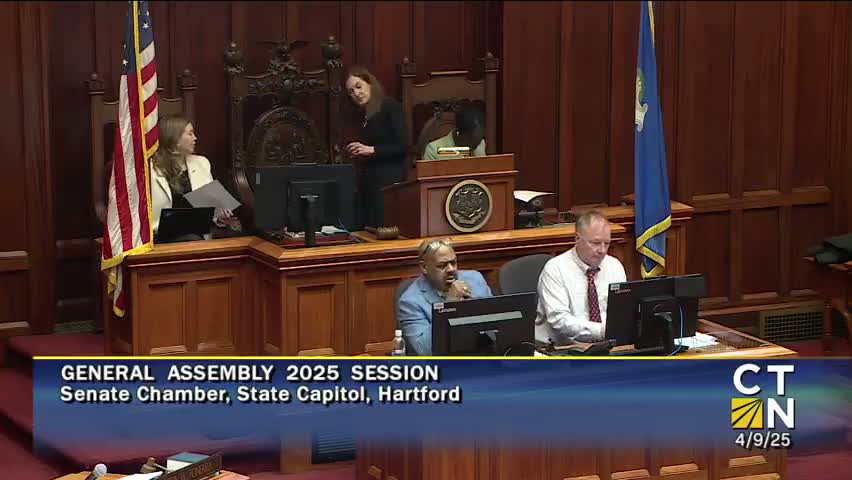
The Connecticut Senate on April 9 approved an emergency-certified measure that excludes Easter Sunday (April 20, 2025) from the statutory early-voting period for a forthcoming special election and temporarily suspends parts of the municipal revenue sharing account spending cap for the fiscal year ending June 30, 2026.
Senator Duff, the bill's proponent, described the measure as "a pretty simple bill," saying its first section "amends [the] early voting statute to exclude 04/20/2025, which is Easter Sunday from early voting time period," and that the change would avoid "requiring registrars and staff to work on Easter Sunday." He said the second section lists exemptions to the spending-cap enforcement — including debt service, special-education court orders or arbitration awards, major disasters and certain capital and pension payments — and temporarily prevents reductions in municipal revenue-sharing grants if a municipality's adopted expenditures exceed the cap for 2025–26.
Senator Perillo said he supported the provision that carves out Easter but asked why the change was limited to this one emergency bill rather than made permanent. "We specifically carved out Easter Sunday when it came down to the presidential primary," he said, urging a longer-term fix when possible.
Senate Republican Leader Senator Harding pressed the majority to explain why the e-cert route was used in place of the normal committee process and also flagged concern about the MRSA waiver's potential effect on property-tax burdens for residents on fixed incomes. "Why we're not fixing it, for good," he asked of proponents, while adding he was "strongly considering still voting for the measure" despite reservations.
Senator Looney supported immediate passage, framing the MRSA waiver as a time-sensitive response to municipal concerns and rejecting claims that the special-election schedule reflected hostility toward religious observance. "I think... this was a case... of someone tripping, not the kick," he said, urging members to back the e-cert.
After debate, an immediate roll call vote on the emergency-certified bill was ordered; the clerk announced that the emergency-certified legislation passed on the floor and the Senate moved to transmit the measure immediately to the House of Representatives.
The bill's changes are narrowly targeted: the early-voting change applies to the specified special-election date and the MRSA adjustments are described as temporary and limited to the fiscal year noted in the bill text. Proponents said the emergency certification was necessary to address a short-term operational conflict and to prevent sudden municipal funding impacts; opponents said a permanent statutory correction would be preferable and should follow the regular committee process.
The Senate adjourned subject to the call of the chair; the clerk handled immediate transmittal to the House following passage.