Get Full Government Meeting Transcripts, Videos, & Alerts Forever!
Get email alerts on the Legislative Votes topic
No spam. Unsubscribe anytime.
Votes at a glance: key measures passed by the Connecticut House
Summary
A roundup of roll-call outcomes from the House floor: fiscal accountability reporting changes, degree authorizations for two institutions, the state police contract reopener, conservation-staffing reforms, multiple environment and public-health bills, and the battery stewardship EPR passed unanimously. Lists outcomes and brief notes for each measure.
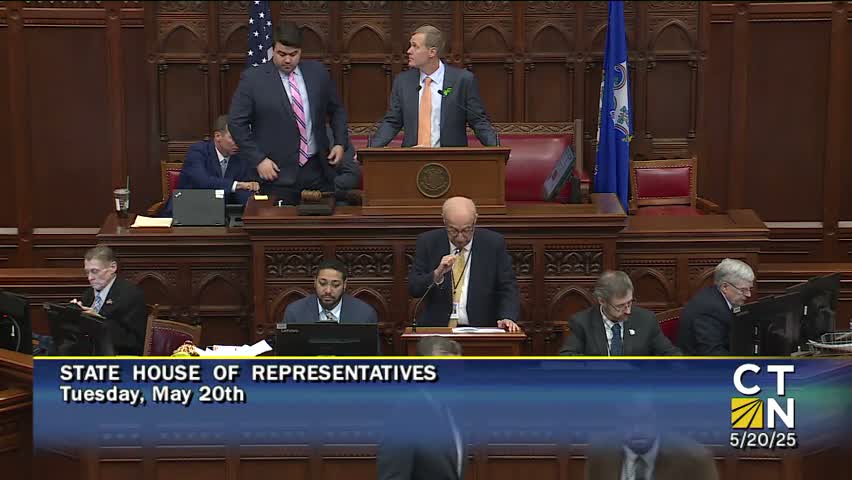
The Connecticut House completed a full floor calendar with multiple roll-call votes on bills and resolutions. Below are the principal measures acted on during the session and their outcomes.
Votes at a glance
- HB 7267 (Fiscal accountability report): Passed, roll call 136–0. The measure requires OPM and OFA annual legislative reports to include estimated changes to non-fixed costs and a budget-reserve stress test. (Proponent: Rep. Constantine) (SEG 143–270)
- SB 1412 (Norwalk Conservatory of the Arts degree authorization): Passed in concurrence, 144–0. (SEG 293–358)
- SB 1424 (International Institute for Astronautical Sciences degree authorization): Passed in concurrence, 145–0. (SEG 359–415)
- HR 17 (Approval of agreement between state and Connecticut State Police Union — wage reopener): Adopted (reported tally: 134–12, 5 not voting). The resolution approves a 2.5% increase for the fourth year of the contract affecting roughly 900 troopers. (SEG 423–844)
- HB 6250 (Staffing for environmental conservation officers — as amended): Passed, roll call 146–0. Amendment directs DEEP to prepare a staffing report. (SEG 846–953)
- HB 6868 (Environmental permitting predictability — as amended): Passed, roll call 147–0. The bill addresses general-permit expirations, wetlands mitigation, natural diversity database study and informational hearing processes. (SEG 956–1440)
- HB 7035 (Prohibiting temporary municipal bans on multifamily/duplex housing): Passed, roll call 94–54 (3 not voting) after extended debate and failed carve-out amendments. (SEG 1443–3818)
- HB 5019 (Extended producer responsibility for consumer batteries): Passed, roll call 147–0 as amended; establishes a manufacturer-led stewardship program for battery collection and recycling, with manufacturers absorbing the collection fee. (SEG 3850–4480)
- HB 7255 (Judicial branch operations and procedures, court ops bill — as amended): Passed as amended. Includes Office of Information Privacy and a habeas working group; amendment adopted by voice vote. (SEG 4483–4982)
- HB 7210 (Halfway houses and residential facilities — as amended): Passed as amended, roll call 100–46; amendment removed DMHAS from the bill’s coverage to address a fiscal-note concern; debate focused on continuity of care, placement and whether certain facilities should be treated differently. (SEG 4985–5364)
- HB 7106 (Advisory council on wheelchair repair — as amended): Passed as amended; codifies Medicaid coverage for medically necessary wheelchair repairs, clarifies timely repair, requires an outreach campaign and sunsets the advisory council. (SEG 5365–5540)
- HB 7214 (Maternal health advisory committee): Passed as amended, roll call 138–3; creates a DPH advisory committee to study perinatal mental health and doula-friendly policies and removed an earlier fiscal-note provision. (SEG 5556–5731)
Next steps: Measures that passed the House will move to the Senate as required, or to the governor for signature if concurrence was already achieved. Several bills contain follow-up reports or administrative tasks for state agencies.