Get Full Government Meeting Transcripts, Videos, & Alerts Forever!
Get email alerts on the Libraries Procurement topic
No spam. Unsubscribe anytime.
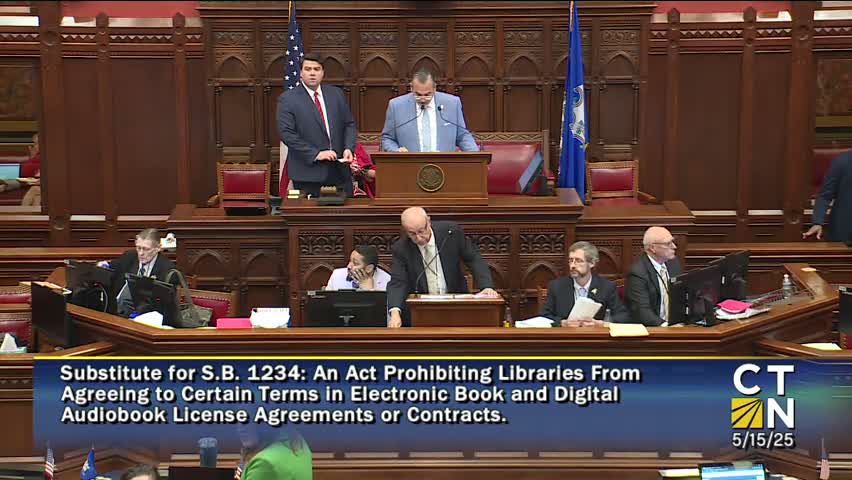
House passes bill aimed at limiting onerous ebook/audiobook license terms for libraries; trigger delayed effect
Summary
After hours of debate and failed amendments, the House passed a measure to bar libraries that accept state funding from agreeing to certain restrictive ebook/audiobook license terms; sponsors added a trigger so the law becomes effective only after other states with a combined population of 7,000,000 adopt substantially similar laws.
The Connecticut House approved Senate Bill 1234, a measure intended to curb contractual terms that public libraries and other state‑funded libraries say make ebooks and audiobooks expensive and short‑lived in their collections. Representative Blumenthal, sponsor of the measure on the floor, said publishers routinely require terms that limit a library’s ability to loan an electronic title (for example, a lender‑imposed cap on the number of loans or a set time period after which the license expires), and that those terms waste taxpayer dollars and reduce patrons’ access.
Key features of the enacted language include prohibitions on certain types of license terms (for example, simultaneous restrictions on both borrow‑count and duration for the same title), protections to preserve libraries’ ability to make non‑public preservation copies in archives, and restrictions on contract clauses that would prevent judicial adjudication of disputes. To reduce the risk of Connecticut being left with no available titles, the bill contains a 'trigger' that makes the law operative only when other states with a combined population of at least 7,000,000 adopt substantially similar laws — a mechanism designed to preserve collective bargaining leverage.
Floor debate was extensive and ranged across issues including whether municipalities should be covered (multiple amendments to remove or allow opt‑outs for municipal libraries failed), whether the bill unlawfully interferes with private contracts or author/publisher sales, and whether federal copyright law and interstate compact issues complicate the approach. Several amendments addressing the bill’s scope and content were proposed and rejected by roll call. After the final tally the clerk announced the bill as passed in concurrence with the Senate.