Lifetime Citizen Portal Access — AI Briefings, Alerts & Unlimited Follows
Design team outlines Burlington Street Bridge options: separated bikeway, multiple ramp types and crossing alternatives
Loading...
Summary
Consultants presented three multimodal bridge cross-sections, options to separate bikes and pedestrians with barriers, and four ways to provide ADA-compliant access to overpasses (including a 900-foot long-ramp option and a redesigned spiral). Jeff Morrow noted existing spirals are not ADA-compliant.
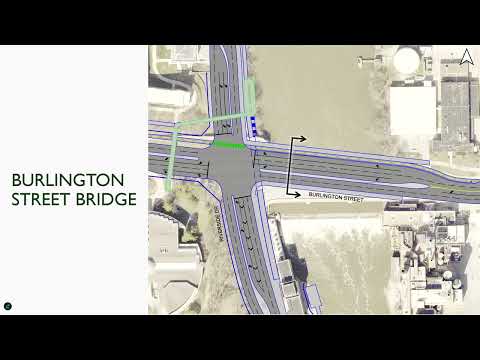
Consultants described multiple design alternatives for the Burlington Street Bridge focused on separating motor vehicles, bicyclists and pedestrians while preserving pedestrian access to campus and hospital corridors.
Jeff Morrow of Anderson Bogart said all vehicle options keep a similar lane arrangement but vary the placement of a protected two-way bikeway and pedestrian paths. "We expect [east–west students] to use [the north side pedestrian way] predominantly," he said, and the options differ in where barriers are placed between cars, bikes and pedestrians.
Morrow described four ways to reach the pedestrian overpasses: a long ramp, a folded ramp, a compliant spiral, and an offset bridge. "So that's where that 900 feet is. It's 450 feet each way," he said when explaining the long-ramp approach. He also said the spirals currently in place "are not compliant with Americans with Disabilities Act" and that the design alternatives include compliant spiral options that stretch the slope to meet ADA requirements.
For crossings, the team presented three choices for crossing Burlington Street itself: at-grade crosswalks with signals (the existing condition), an underpass (similar to the Iowa Avenue underpass), or an overpass with compact spiral connections on the constrained side.
The consultants emphasized trade-offs: designs that reduce travel distance for able-bodied pedestrians tend to rely more on stairs, while fully ADA-compliant ramps increase travel distance. The team invited public input on which combinations of separation, barrier type and access approach best balance daily use, event surge capacity and accessibility.