Get Full Government Meeting Transcripts, Videos, & Alerts Forever!
Get email alerts on the Long Term Care Antidiscrimination topic
No spam. Unsubscribe anytime.
House passes amended bill requiring training and nondiscrimination protections for long‑term care residents
Summary
After hours of debate, the Connecticut House adopted an amended bill that mandates cultural‑competency training, recordkeeping, signage and nondiscrimination protections for residents of DPH‑regulated long‑term care facilities; supporters framed it as dignity and privacy protections, opponents raised safety, privacy and religious‑liberty concerns.
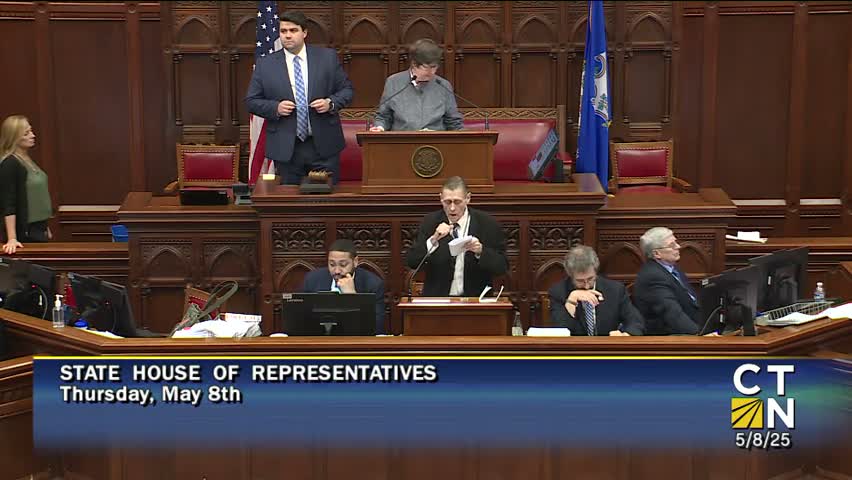
The Connecticut House of Representatives passed an amended version of House Bill 6913 on a 124–19 roll call after extensive floor debate over the measure’s scope and wording.
Representative Shannon, the bill’s sponsor, said the measure updates long‑term care rules to ensure that residents who are lesbian, gay, bisexual, transgender or living with HIV “are treated with respect and have the dignity they deserve,” and to add cultural‑competency training for facility staff and clearer complaint and posting procedures. “We want to make sure that staff have the proper education and the proper training so that when patients come in ... they are safe and respected in these facilities,” Shannon said.
Opponents argued the text as drafted risks unintended consequences for other residents. Representative Mastro Francesco, a frequent critic on the floor, characterized the measure as overbroad and said it could force a frail nursing‑home resident to accept a roommate she did not want. “This whole entire bill, on its face, is discriminatory,” he said during floor debate, describing scenarios in which an elderly resident might be uncomfortable sharing a room with a biologically male roommate who identifies as female.
The adopted House B amendment removed a narrower penalty provision from the original draft and clarified several enforcement and training provisions. The bill requires Department of Public Health‑mandated cultural‑competency training focusing on residents who identify as lesbian, gay, bisexual, transgender or gender nonconforming or who are living with HIV, and directs facilities regulated by DPH to post statements about nondiscrimination and to maintain certain resident records including preferred name and gender identity when provided. The text says residents may request room changes and clarifies that a change may not be denied on the sole basis of another resident’s gender identity, sexual orientation or HIV status; it also preserves a clinical override for medical necessity.
Supporters framed the bill as a modernization of policies for a changing resident population and as a dignity and public‑health measure. “We are updating procedures so that some of the greatest fears that I hear from the LGBTQ community is that they are not allowed into the room of their spouse,” Representative Hughes said, citing improved privacy and training provisions for post‑hospital placements.
Opponents repeatedly asked for clarifications about how the rules would apply to memory‑care units, to residents with dementia, and to religiously affiliated facilities. Sponsor Shannon responded that facilities regulated by DPH would be subject to the rule set and that facilities not regulated by DPH could be outside its scope. She also said ombudsman and DPH complaint processes would be the channels for resolving disputes.
The clerk announced the final roll call as 124 yes, 19 no, 8 absent; the bill as amended passed and will move to the next stage for final processing.
The House debate included requests for more detailed guidance on operational issues (room assignment processes, record‑keeping time frames, and training implementation), and members signaled intent to propose follow‑up clarifications in future amendments or legislation.
The House acted on the bill after adopting House Amendment B, which the sponsor described as streamlining and neutralizing language to broaden protections and clarify enforcement pathways. The department charged with implementation will issue regulations and training guidance to regulated facilities.