Get Full Government Meeting Transcripts, Videos, & Alerts Forever!
Get email alerts on the Clean Energy topic
No spam. Unsubscribe anytime.
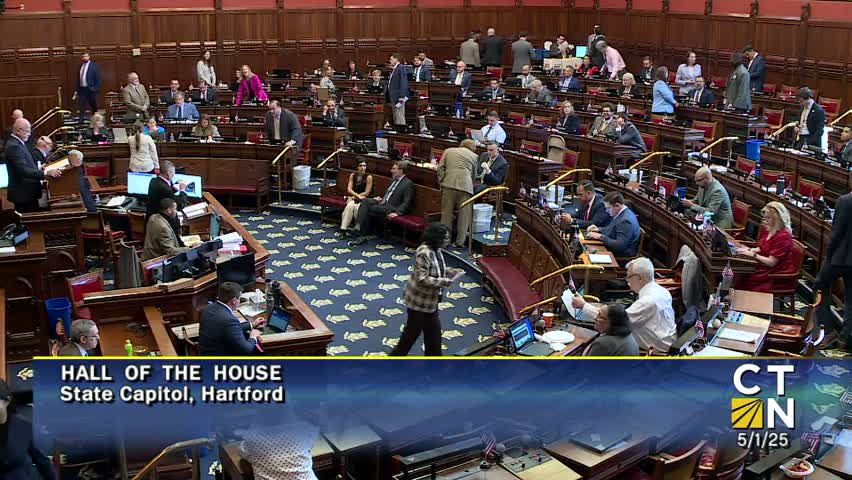
House adopts broad environment bill to set targets, boost clean economy and plan heat‑pump deployment
Summary
Lawmakers adopted substitute HB 5004 after extended floor debate. The bill sets greenhouse‑gas targets, directs DEEP and other agencies to produce inventories and plans, expands grant and tax‑incentive priorities, and creates workforce and financing studies for heat‑pump deployment; members questioned costs, grid reliability and implementation specifics.
The House passed substitute HB 5004, a comprehensive environment and clean‑energy measure that sets new goals for greenhouse‑gas reductions, tasks state agencies with inventories and planning, and expands eligibility for certain incentive programs and workforce initiatives.
Representative John Michael Parker, chair of the Environment Committee, opened debate by saying, “This bill aims to protect the environment,” and described three main goals: painting a picture of a desired future and building collaborative plans, encouraging energy efficiency, and supporting a clean economy with workforce development and business incentives. "This bill aims to protect the environment," Parker said in his floor overview.
The bill directs the Department of Energy and Environmental Protection (DEEP) to publish greenhouse‑gas inventories, consider the social cost of greenhouse gases in project assessment, and require agencies to design plans to reach economy‑wide reductions (a 65% carbon reduction target by 2040 and net‑zero by 2050 were discussed in floor exchanges). It also authorizes DECD to prioritize job‑creation tax rebates for projects that demonstrably support sustainable practices, expands some grant program eligibility to low‑income/owner‑occupied homes, and establishes a Clean Economy Council to advise on workforce transitions from fossil‑fuel jobs.
Floor debate was lengthy. Representative Callahan and others pressed the bill’s proponents on how social‑cost calculations will be done, whether the bill creates mandates for heat‑pump installation in schools or state buildings (sponsors said the language requires studies and consideration, not immediate mandates), and how the state will secure baseline, dispatchable power to meet increased electricity demand from electrification. Proponents repeatedly emphasized planning, not immediate new programs or broad new appropriations — several sections direct studies to identify financing and implementation approaches.
Representative Callahan warned of potential cost and reliability risks and asked how the state would meet added electric demand; Representative Parker replied the bill asks agencies to devise plans that address those questions and that the legislation focuses on planning, affordability and public‑health protections. Other members raised concerns about potential rate impacts and the scale of required renewable generation; supporters pointed to resilience gains, potential long‑term savings from efficiency and avoided climate damages.
After amendment and debate the House adopted the bill as amended by House A; the clerk announced the vote on the floor (transcript records the final tally as 98 ayes and 47 nays on that roll call as reflected in the transcript). The bill now proceeds to the Senate or next step for consideration.