Get Full Government Meeting Transcripts, Videos, & Alerts Forever!
Get email alerts on the Energy Affordability topic
No spam. Unsubscribe anytime.
House approves comprehensive energy package (SB 4) aimed at lowering bills through securitization, procurement changes and pilots
Summary
After hours of floor debate the House passed SB 4, a wide-ranging energy bill that reduces some public‑benefits charge items, authorizes securitization of storm and program costs, encourages new procurement approaches, and establishes pilots for community solar plus storage and smart‑meter planning. Supporters said it balances affordability and program integrity; critics warned of long‑term tradeoffs.
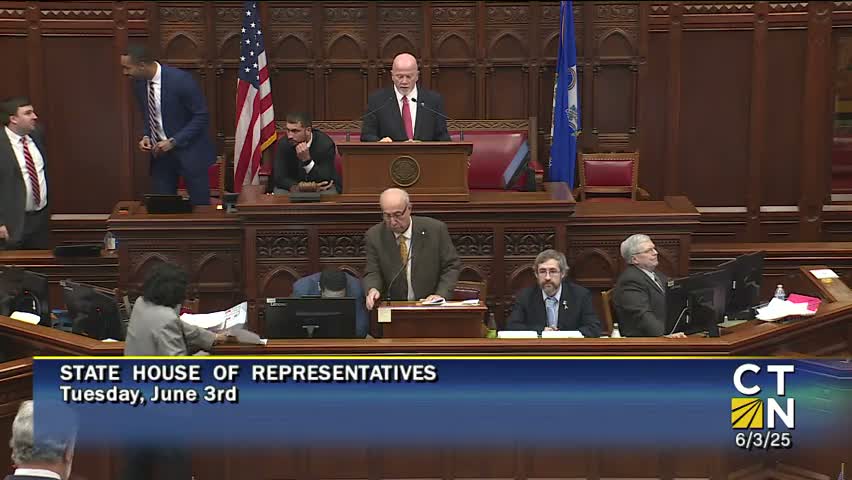
The House adopted Senate Bill 4 on June 3 after an extended floor debate that ran through a series of energy topics including public‑benefits reductions, securitization of certain legacy costs, procurement reforms and pilot programs for community solar and storage.
Representative Matt Steinberg, chair of the Energy & Technology Committee, described the measure as a three‑part effort focused on affordability, access and accountability: “This bill is intended to address Connecticut's high energy costs,” he said on the floor. Lawmakers said the package aims to reduce rate‑payer bills by removing select public‑benefits charges and by authorizing rate‑payer‑backed bonds (securitization) to spread extraordinary storm and program costs over time. Supporters estimate aggregated savings that could approach several hundred million dollars over multi‑year horizons when securitization and program efficiencies are included.
The bill also seeks to change procurement practice so utilities can act with more flexibility and to create targeted pilots: a community‑solar plus storage pilot intended to test whether private capital paired with storage can shave peak demand; and an advanced‑metering infrastructure (AMI) pathway, paired with outreach and opt‑in smart‑meter options, to enable time‑varying rates and consumer load management. Sponsors said AMI and dynamic pricing could cut consumption and help households control bills; opponents warned of large upfront costs and the risk of shifting costs to non‑participants.
Lawmakers debated eligibility limits for EV charging incentives, adjustments to solar incentive programs and protections for low‑income customers (including the continued availability of medical hardship and low‑income discounts). The bill directs multiple agencies and regulators (DEEP, PURA, OPM, and OCC) to carry out studies and implementation. Representative Steinberg said that if pilots do not deliver savings, they will not be renewed; he emphasized safeguards and reporting requirements.
After floor remarks and questions about implementation timing, smart‑meter cost recovery and the effect on natural‑gas dependence, the House recorded the roll call. The clerk announced the tally for SB 4 as amended: total voting 147; Yeas 144; Nays 3; Absent 4. The bill passed in concurrence with the Senate.
Next steps include agency rulemaking, a PURA evaluation of procurement and AMI pilot details, and bond authorizations and administrative actions necessary to effect securitization or program changes. Supporters urged ongoing monitoring to ensure the changes produce the expected rate‑payer savings without unintended cost‑shifts.