Get Full Government Meeting Transcripts, Videos, & Alerts Forever!
Get email alerts on the Humanitarian Response topic
No spam. Unsubscribe anytime.
MSF Field Lead Annie Fjord Describes Aid Challenges in Gaza, Nigeria and Yemen at Iowa City Forum
Summary
Annie Fjord, a Danish nurse and Médecins Sans Frontières field medical team lead, recounted missions treating lead-poisoned children in Nigeria, running cholera and malnutrition centers in Ethiopia and Yemen, and operating amid severe constraints in Gaza, telling an Iowa City audience that "silence can certainly kill."
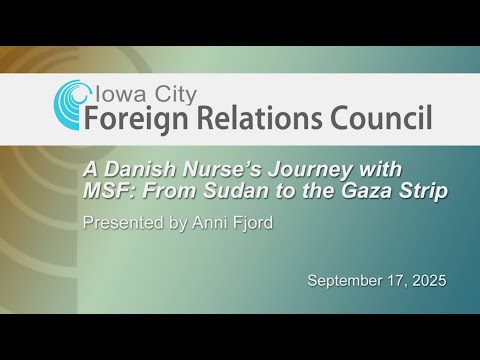
Annie Fjord, a Danish nurse and field medical team lead for Médecins Sans Frontières (MSF), told an Iowa City audience on Sept. 17 that humanitarian operations in conflict zones face mounting barriers to treating the sick and protecting local staff.
Fjord spoke at the Iowa City Foreign Relations Council, recounting deployments to Nigeria, Bangladesh, Ethiopia, Yemen and Gaza and describing on-the-ground responses to mass lead poisoning, cholera outbreaks and severe malnutrition. "Silence can certainly kill," she said of MSF's duty to bear witness to atrocities and shortages.
Fjord described a northern Nigeria outbreak in which many children were dying; blood tests linked the deaths to high lead levels from informal gold processing that brought contaminated dust into homes. MSF teams treated cases and led environmental remediation — including excavating contaminated soil — while providing follow-up and nutritional support.
She highlighted the role of ready-to-use therapeutic foods in treating malnutrition, noting that calorie-dense, nonperishable formulations allow clinicians to discharge stabilized children for outpatient follow-up. In describing field triage, Fjord referenced MUAC (mid-upper arm circumference) screening to quickly identify children in need.
On Gaza, Fjord said MSF has been able to deliver some supplies when borders briefly opened but that access is severely constrained and evacuations for specialized care are rare. "We are still doing what we can do, but it's of course, it's not enough," she said, adding that the organization continues to support the only functional hospital in the south and run some clinics.
Fjord also reported recent staff casualties. She told the audience that 13 local MSF staff were killed in a recent incident and described the toll on local teams who repeatedly move to avoid danger.
Addressing coordination, Fjord said international agencies such as the World Health Organization play a formal role but that emergency coordination of multiple NGOs is often chaotic; she said MSF's routine collection of clinical data sometimes gives it a stronger voice in local operational planning.
The forum included questions from the audience on long-term neurological effects of lead exposure in Zamfara State, MSF's ability to get medicines into Gaza, the length of deployments, staff mental-health supports and how MSF plans for withdrawal when local capacity is limited. Fjord said deployments typically range from three months for emergency missions to a year for first-time field assignments, that staff receive psychological briefings and R&R when feasible, and that MSF tries to plan pull-outs while noting standards often decline after withdrawal.
Peter Gerlach, executive director of the Iowa City Foreign Relations Council, introduced Fjord and emphasized the organization's reliance on donations and volunteer support to keep programs free and accessible.
The program ended with a short question-and-answer session and a reminder that the ICFRC's next public program in the fall series is scheduled for Sept. 26 at the Iowa City Senior Center.
What was said and sources: the article is based on Fjord's presentation and the question-and-answer session recorded at the Iowa City Foreign Relations Council event.