Get Full Government Meeting Transcripts, Videos, & Alerts Forever!
Get email alerts on the Immigration Enforcement topic
No spam. Unsubscribe anytime.
Scholars at Iowa City forum warn expanded enforcement and detention threaten migrants, families and local services
Summary
At an Iowa City Foreign Relations Council program, historians Adam Goodman and Lina Maria Murillo traced a long U.S. history of deportation, warned that recent funding and DHS messaging aim to induce self-deportation, and urged support for local mutual-aid and legal organizations.
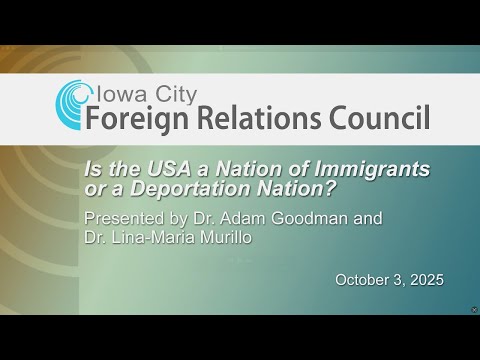
Iowa City — At a public program hosted by the Iowa City Foreign Relations Council on Oct. 3, 2025, historians Adam Goodman and Lina Maria Murillo traced more than a century of U.S. deportation practice and warned that recent federal funding increases and enforcement tactics risk expanded removals, family separations and strain on local services.
"They're meant to terrorize," Lina Maria Murillo said of recent raids and publicity around enforcement, arguing those actions are intended to frighten both targeted communities and the wider public. Murillo cited recent local arrests and national examples to argue that deterrence through spectacle is now an explicit component of policy.
Adam Goodman described the long arc of U.S. deportation and removal systems, saying the majority of removals historically have occurred outside full judicial proceedings. "Eighty-five percent of people deported... have been through expedited streamlined means that give people little if any opportunity to fight for their case," Goodman said, noting the prevalence of non-judicial mechanisms and "voluntary departures" that are often compelled by circumstances.
Both panelists said recent policy changes increase the risk of larger-scale enforcement. Goodman noted a recent surge in enforcement funding and the growth of detention capacity, warning that once detention infrastructure and contracted centers exist, "there's a certain amount of bureaucratic inertia" that makes later reductions difficult.
Murillo raised the human stakes, highlighting children and caregivers who would be disproportionately affected: she cited reporting that DHS has offered stipends to encourage some children to "self deport," and warned that raids on workplaces or child-care centers would disrupt local caregiving networks and essential services.
Panelists also discussed political drivers and historical parallels. They said both Democratic and Republican administrations have supported large-scale enforcement at different times, and traced links between deportation policy and racialized narratives about who belongs in the United States.
In response to audience questions, panelists emphasized a multi-pronged defense strategy: legal challenges, local pressure on elected officials, and investment in community organizations that provide direct support. Murillo and Goodman named local groups (for example, the Prairie Land Freedom Fund and the Immigrant Welcome Network of Johnson County) and urged financial and volunteer support to shore up services.
The event closed with a call to action to support local mutual-aid and legal-defense organizations and a reminder of upcoming ICFRC programs. Peter Gerlach, the council's executive director, also appealed for donations to sustain the nonprofit's free public programming.