Get Full Government Meeting Transcripts, Videos, & Alerts Forever!
Get email alerts on the Public Safety Joint Operations Center topic
No spam. Unsubscribe anytime.
Montgomery County committee approves $2.43 million to create Public Safety Joint Operations Center
Summary
The Montgomery County Public Safety Committee approved a $2,430,000 supplemental appropriation to renovate space at Public Safety Headquarters into a Joint Operations Center (JOC) that will colocate police, fire/rescue and emergency management functions to improve real-time coordination, with staff directed to tighten data governance and transparency safeguards.
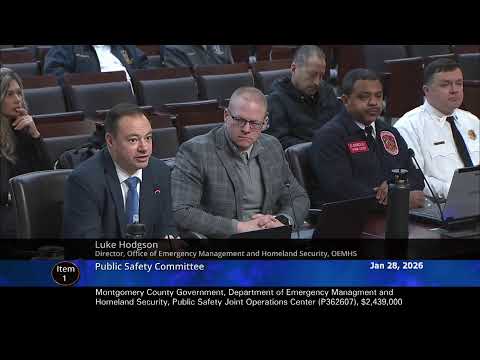
Montgomery County’s Public Safety Committee on Jan. 28 approved a $2,430,000 supplemental appropriation to renovate an existing storage room at Public Safety Headquarters and create a Public Safety Joint Operations Center intended to colocate police, fire/rescue and emergency management analysts and supervisors.
Committee members moved and seconded a resolution to amend the FY 2530 capital improvements program and supplemental appropriation number 26-40 to the FY ’26 capital budget for the Montgomery County Department of Emergency Management and Homeland Security Public Safety Joint Operations Center in the amount of $2,430,000. Councilmember Lukey moved the measure, and another councilmember seconded; the chair indicated the committee expected a 3–0 approval and then adjourned this portion of the meeting.
Proponents said the JOC would bring together existing units — the real-time intelligence center, drone-as-first-responder unit, EMS transport disposition officer and the public alert and warning system — to enable unified command, resource tracking and system-wide overwatch. “This will bring together supervisors and analysts from police, fire and rescue, and emergency management and homeland security to ensure cross disciplinary coordination in response to emergency incidents at all times of the day,” a presenter said during the briefing.
Presenters argued the consolidation is intended to reduce duplication, improve situational awareness, shorten response times and free field commanders from information overload by converting incoming data into operational intelligence. The renovation request includes network connectivity, cabling and switches, electrical upgrades, a video wall, radio systems and furniture, modular partitions, and additional software and licenses to make the space operational.
Council staff urged caution on data governance and transparency, noting the colocated services regularly handle sensitive information and that the staff report (pages 6–7) flags potential vulnerabilities. “Council staff advises the committee to understand the current policies in place for all relevant agencies for data collection, use, security, and oversight,” staff said, recommending departments consider dedicated staff for data integrity and produce publicly accessible data-management policies, especially if artificial intelligence will be used.
Officials acknowledged the racial equity impact assessment summarized in the packet (pages 7–8) is inconclusive. Paul Stoddard, assistant chief administrative officer in the Office of the County Executive, said he generally agreed with those concerns and urged consistent policies governing surveillance-based technologies so the public understands how shared systems will and will not be used.
Several committee members pressed department leaders on operational roles. One member asked for clarification of language in the packet that describes the police operations center "serv[ing] as the chief’s proxy" during off hours; police and fire officials said existing duty commanders and analysts will continue to carry out those responsibilities, but the JOC will provide a centralized room and analytic support so commanders are not managing from vehicles with a single screen.
Councilmember Lukey, joining remotely, asked whether access to cross-disciplinary data would follow least-privileged access principles so that only those detailed to the JOC would receive broader access. Officials said current tools and policies will remain and that the JOC would comply with existing rules and regulations while creating a single place for coordinated analysis.
The committee discussed potential uses of artificial intelligence to help identify unique incidents amid high volumes of similar calls (for example, distinguishing a separate cardiac-arrest call among many accident reports), while emphasizing that human analysts would make final determinations. Members also cautioned against over-disclosing cybersecurity details to the public while endorsing transparency about how systems function.
Presenters said pre-construction work is ready to begin upon funding approval and described a roughly 90‑day target to make the space operational once funding is received. Tasks listed included demolition of prior tenant buildouts, partition installation for security and sightlines, running network and power to the space, and routing radio antenna connections from the roof to the operations room.
Staff noted future operational or capital requests could follow — for example, construction of bunk rooms or a kitchen — and that those would be reviewed separately to avoid duplicative services. Officials also said projected cost savings from centralized operations have not yet been quantified and would be shared later as case studies once the JOC is operational.
The committee voted to approve the supplemental appropriation and adjourned this portion of the work session; the meeting was recessed so the room could be reconfigured for the next joint public safety meeting.
What's next: the council will implement the renovation work upon appropriation and departments have been asked to return with or coordinate publicly accessible data-governance and oversight policies tied to the JOC’s operations.