
Seneca County adopts housing strategy; funding plan to be developed
Get AI-powered insights, summaries, and transcripts
Subscribe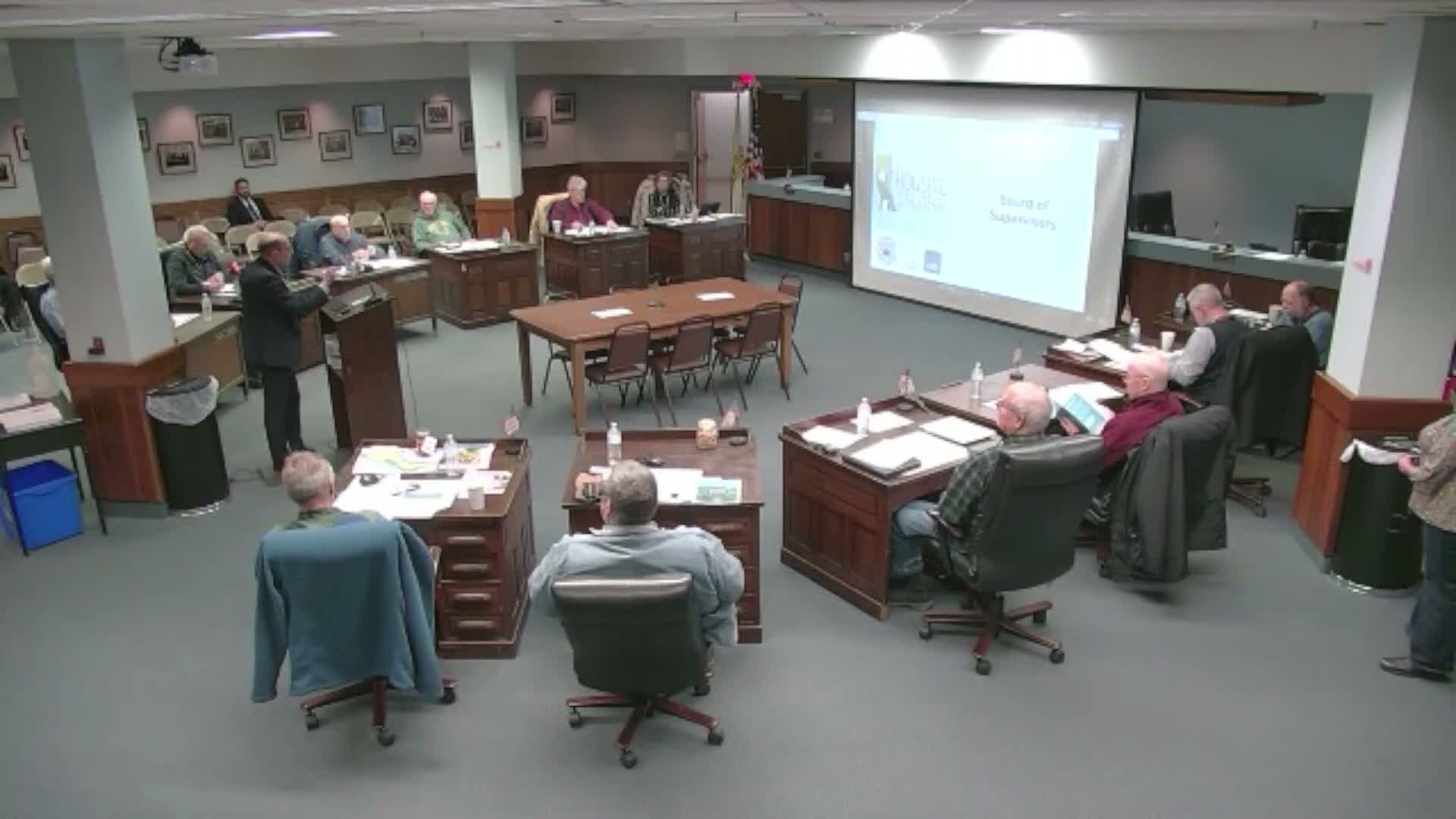
Summary
County supervisors voted to adopt a CZB‑prepared housing strategy that recommends a $1,000,000‑per‑year housing trust fund and local capacity building; the board did not commit funding and directed committees to develop financing and implementation plans.
Seneca County supervisors voted to adopt a housing strategy prepared by CZB LLC after a consultant presentation on Jan. 27.
Pete Lombardi of CZB summarized the plan as addressing two separate problems: affordability driven by low incomes and market weakness that keeps higher‑income households from choosing Seneca. "Here, the affordability challenge exists for low income households, especially for single earners, who work in the service sector," Lombardi said. He told supervisors the county is unique among peers in having fewer than 30 percent of households with incomes above $100,000.
The consultant identified a roughly "$100,000 per unit" financing gap for both subsidized and market‑rate development and urged the county to pair federal and state affordability tools with local, flexible resources and increased county capacity. As a foundational recommendation, CZB proposed setting a goal and "committing $1,000,000 per year over 10 years to the Seneca County Housing Trust Fund from local resources so that you have some local unrestricted dollars," Lombardi said. He emphasized that those local funds would be unrestricted by federal grant rules and could be used to incentivize infill, adaptive reuse, small rental rehabs and downtown investments.
Supervisors asked whether the strategy requires the county to build a fixed number of units. Lombardi said implementation should focus on quality, systems, and delivering an initial set of projects to "build confidence" in the market rather than a single numeric target. He described a multi‑stage program design period (roughly 8–16 months) to establish program rules, a program coordinator, and a pipeline of projects.
At a following government operations committee meeting, supervisors accepted a $2,000 Pomeroy Foundation grant and then moved to adopt the CZB strategy. The committee carried the motion by voice vote. County leaders repeatedly noted that adopting the strategy is a policy decision; any use of county funds would require later, separate budget and committee action. The board did not appropriate the $1,000,000 per year recommendation at the meeting and instructed relevant committees to return with detailed funding and implementation proposals if the strategy is adopted.
The board and the consultant also discussed local tactics that could support the plan, including zoning to allow accessory dwelling units, small matching grants to spur block‑level improvements, and technical assistance for small developers. Lombardi said short‑term rentals (Airbnbs) are a factor but a "second or third tier" issue compared with structural market weakness.
Next steps: the board adopted the strategy as a guiding document; supervisors said they will revisit funding and program design in committee and before any county appropriation is made.