Get Full Government Meeting Transcripts, Videos, & Alerts Forever!
Get email alerts on the Moss 3 Landfill topic
No spam. Unsubscribe anytime.
Residents, scientists and unions urge supervisors to oppose proposed Moss 3 landfill
Summary
Dozens of residents, union representatives and at least one federal biologist told the Russell County Board of Supervisors they oppose the proposed Moss 3 landfill, citing karst geology, proximity to the Clinch River watershed and doubts about long-term liner performance. Speakers urged hydrology and geology studies and asked the board to reject host agreements and stop the project.
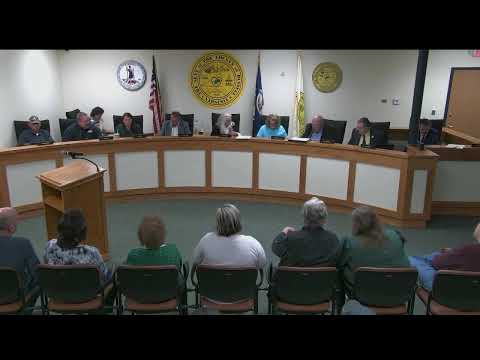
Dozens of residents, union leaders and conservation experts addressed the Russell County Board of Supervisors during an extended public-comment period on April 8, urging supervisors to oppose the proposed Moss 3 landfill and demanding more scientific study before the county proceeds.
"We should do our own thorough investigation of these landfill promises," Amy Branson, a Castlewood pharmacist, told the board, urging hydrology and geology studies before any deal. Betty Dickinson, speaking from Hurls Valley Road, warned that "Dumps Creek feeds right into the Clinch River less than a mile away," adding that the site's karst geology and reported faulting make it especially vulnerable to leachate reaching groundwater and springs.
Dr. Jess Jones, a biologist with the U.S. Fish and Wildlife Service and a faculty member at Virginia Tech, described the Clinch River watershed as a biodiversity hotspot and warned of risks to endangered freshwater mussels. "Freshwater mussels are one of the most endangered groups of animals in the country," Jones said, noting multiple endangered mussel species in the Clinch and the risk that spills or chronic leakage from a landfill could harm mussels, their fish hosts and habitat.
Union representatives and labor allies framed the site as historically significant and urged preservation of local labor history. Kim Fife, speaking on behalf of Communications Workers of America Local 2204, said the Moss 3 area "is sacred land" connected to the 1989 Pittston coal strike and Camp Solidarity.
Speakers also raised fiscal and procedural concerns: several commenters said host agreements and changes to the county's solid-waste ordinance must be addressed before any landfill permitting proceeds, and others warned that liner systems have limited lifespans and that communities can inherit cleanup costs after bond periods expire. "All landfill liners have a lifespan," one commenter said; "it's not a question of if it will fail and release the liquids ... it's a question of when."
The board did not take an immediate vote on the landfill during the meeting. The chair closed public comment and moved on to other agenda items; speakers asked supervisors to consider independent technical reviews and to withhold approval of any host agreement until the data are available.
What happens next: The board discussed permitting and related processes elsewhere in the meeting but took no final action on the landfill at this session. Public commentators asked the supervisors to require geotechnical and hydrological data before advancing any host agreement or ordinance changes.