Get Full Government Meeting Transcripts, Videos, & Alerts Forever!
Get email alerts on the Zoning And Land Use topic
No spam. Unsubscribe anytime.
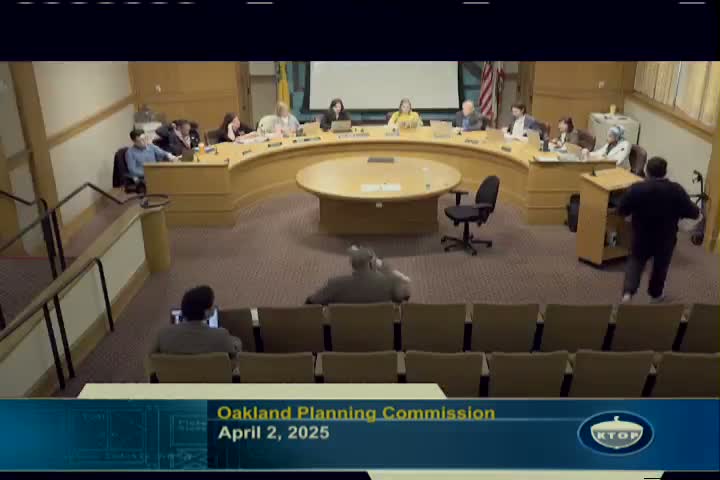
Oakland planning commissioners deny Suprema Meats' appeal over 952 57th Street operations
Summary
The Oakland Planning Commission unanimously denied an appeal by Suprema Meats, finding the appellant did not provide sufficient evidence that warehousing activity at 952 57th Street predated an October 2023 zoning change that made warehousing conditional in the HBX-1 zone.
The Oakland Planning Commission on April 2 denied an appeal by Suprema Meats and affirmed a staff determination that warehousing activity at 952 57th Street requires a conditional use permit.
Case planner Neil Gray told commissioners the city received a complaint last year that Suprema Meats had expanded into 952 57th Street and concluded the activity lacked the conditional use permit required in the HBX-1 zone. Gray said staff issued a notice of violation on May 15 and a planning determination on Dec. 11, and recommended denying the appeal because the appellant had not provided documentation showing the warehousing use predated the ordinance that made warehousing conditional.
Michael McGrew, representing Suprema Meats, submitted a grant deed showing the property transferred in July 2023 and a sworn declaration saying the new owner immediately used the space. "The deed shows that the property was transferred ... in July 2023," McGrew said, and argued that, if accepted, the evidence would establish a continuing use before the ordinance took effect Oct. 30, 2023.
Staff and several commissioners pushed back on the sufficiency of that evidence. Gray said a deed alone does not prove an activity began on the date of sale and that the city typically looks for zoning clearances, business licenses, receipts, utility bills or other written documentation to confirm use. Deputy city attorney Michael Branson cited the appeal standard in the municipal code requiring appellants to show an error or abuse of discretion by staff.
Commissioners said the record before them did not demonstrate that staff had erred. Commissioner Shahar Shirazi, who moved to deny the appeal, said the commission needed evidence beyond an affidavit and deed to conclude the property had been used for warehousing before the zoning change. Several commissioners noted staff had previously listed available forms of evidence the appellant could provide and that those items were not in the record.
Commissioner Shirazi moved to deny the appeal and affirm staff's determination; Commissioner Raab seconded. A roll-call vote recorded unanimous support from Commissioners Raab, Shirazi, Arons, Lee, Vice Chair Natalie Sandoval and Chair Jennifer Rank. The commission announced the decision as final.
Next steps: staff noted that even if the commission denies the appeal, the property owner may still pursue a conditional use permit or provide evidence to support a zoning clearance in a separate application; staff said a successful zoning-clearance finding for a legal nonconforming use would require different documentation and process from an appeal of the December determination.