Get Full Government Meeting Transcripts, Videos, & Alerts Forever!
Get email alerts on the Planning Code Amendments topic
No spam. Unsubscribe anytime.
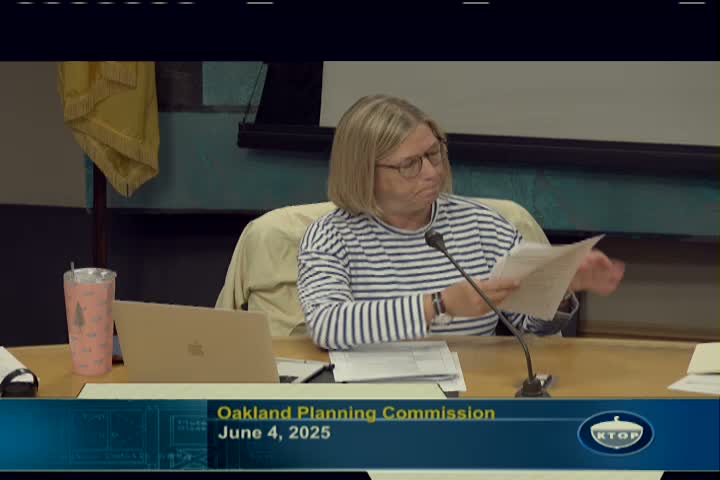
Oakland Planning Commission unanimously recommends citywide planning code amendments to City Council
Summary
The Planning Commission voted unanimously June 4 to recommend staff’s omnibus planning code amendments — clarifying design-review exemptions, adding a ministerial design-review pathway for many small housing projects (up to 30 units and certain affordable projects), and adjusting several thresholds — and will transmit the recommendation to City Council for hearings in June and July.
The Oakland Planning Commission unanimously voted June 4 to recommend a package of citywide planning code amendments intended to streamline design review for housing and other development and to align local rules with recent state housing laws.
Staff described the proposal as an omnibus set of changes that clarify exemptions and procedures for design review, introduce a new ministerial design-review process for qualifying projects (including 100% affordable projects and projects of up to 30 units), update thresholds for large developments and industrial buffers, and revise demolition and historic-preservation language. “These are omnibus planning code amendments proposed, related, generally to design review,” Laura Kaminski, strategic planning manager, told the commission during the presentation.
The staff presentation situated the amendments within state law and the city’s housing element, citing recent state statutes (SB 35, SB 9 and other state streamlining provisions) and council resolutions that directed adoption of objective design standards and by-right approval processes. Staff said the ministerial pathway is intended to reduce predevelopment costs and expedite approvals for small infill and affordable projects.
Staff also described several targeted edits requested by the Zoning Update Committee and community groups. In response to a comment letter from the Oakland Heritage Alliance, staff proposed retaining certain downtown code text that had been slated for removal and clarified language about exceptions for projects sited on properties listed on the National Register. Staff further said they will continue to treat demolition-findings language on ‘‘reasonable economic return’’ as a complex topic to be evaluated separately in a future package.
The commission accepted supplemental materials submitted by staff for today’s meeting by a roll-call vote. Vice Chair Natalie Sandoval moved to accept the supplemental changes and Commissioner Josie Aarons seconded; staff then presented those supplemental edits to the commissioners.
Public commenters included Mary Harper of the Oakland Heritage Alliance, who read portions of OHA’s June 4 letter arguing that certain by-right and discretionary procedures should not be conflated; Naomi Schiff, who urged that zoning code bulletins be incorporated into the planning code so applicants can more easily find guidance; and architect Kirk Peterson, who pressed staff on how the city assesses ‘‘reasonable economic return’’ when reviewing demolition requests. Staff responded that market-analysis guidelines and demolition-finding criteria are available through Planning Department guidance and that the specific demolition provisions may be revisited in a separate process.
After deliberations and technical clarifications from staff, Commissioner Rob moved and Commissioner Aarons seconded a motion to recommend the planning code amendments, including the supplemental changes dated 06/04/2025. The motion passed unanimously by roll call. Staff said the recommendation will move to the Planning Department’s transmittal schedule with a Community and Economic Development hearing on June 24, first reading July 1, and second reading July 17 at City Council.
The commission did not adopt changes to demolition economic-return language at today’s meeting; staff said the matter will be examined in a future, focused review. The commission also asked staff to prepare materials and a timeline for council hearings and to return with objective design standards on a separate agenda item for additional input.
The Planning Commission’s recommendation is advisory; formal adoption will take place through the City Council process.