Get Full Government Meeting Transcripts, Videos, & Alerts Forever!
Get email alerts on the Housing Apr Adus topic
No spam. Unsubscribe anytime.
Oakland staff: 2024 APR shows limited RHNA progress; ADU survey suggests ADUs add lower-cost units but data are preliminary
Summary
City staff told the Planning Commission that Oakland permitted about 11% of its RHNA in the first two years of the cycle and that a local ADU survey (128 responses) suggests many ADUs are renting at lower-income price points; staff said the survey is preliminary and will be followed by a supplemental survey and further monitoring.
Oakland planning staff on June 18 told the Planning Commission that the city has permitted roughly 11% of its Regional Housing Needs Allocation (RHNA) over the first two years of the current cycle and that an initial local survey of accessory dwelling units (ADUs) indicates a substantial share are affordable by design — but the data are limited.
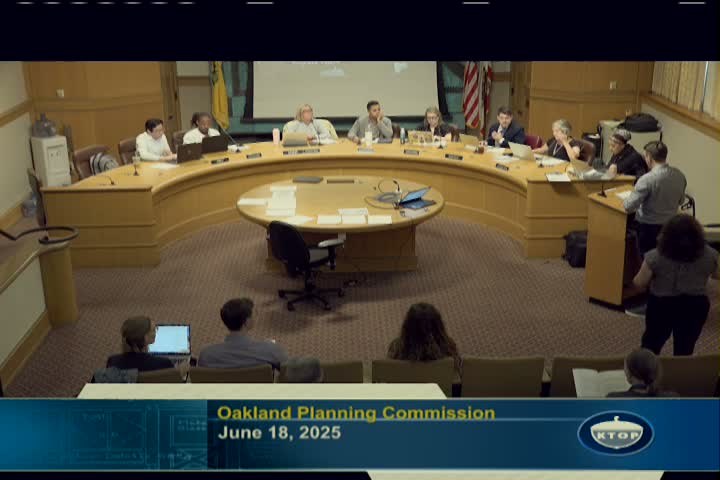
Timothy Green, planner 3 in the Planning & Building Department, told commissioners the city received applications for about 2,665'2,666 units in 2024, issued building permits for 1,028 units and certificates of occupancy for 2,249 units. He said staff recorded 1,883 proposed affordable units in application submittals, entitled 1,333 affordable units, issued permits for 805 new affordable units and recorded 681 completions in 2024.
The nut of the staff presentation was the city's RHNA progress: "Over the first 2 years of the RHNA cycle, only 11% of Oakland's total RHNA has been met thus far," Green said. He and other staff noted permitting has been stronger for very low and low income units and weaker for moderate-income units (7% of moderate-income RHNA permitted).
Emily Weinstein, director of Housing and Community Development, framed affordability context and described the ADU survey the city carried out in February 2024 of property owners who built ADUs between 2018 and 2023. "This survey received 128 responses and an 11% survey response rate and represents 142 ADUs," Weinstein said, but she cautioned that only 61% of respondents reported rent and the effective response rate for the rent question was about 7%, so results are preliminary.
Still, staff reported that among respondents who provided rents, 60% of ADUs qualified as low-income, 21% as very-low income, 18% as moderate-income and 1% above-moderate, and that 73% of reported ADUs were single-family Category 1 or 2 units. Staff recommended treating ADUs in the APR as non-deed-restricted affordable units using ABAG-derived ratios for the first two years, noting that the state temporarily allowed use of regional analysis for the initial reporting period.
Commissioners pressed staff on limitations and next steps. Commissioner Owen Lee asked whether the city could count other non-deed-restricted permanent units (not just ADUs) toward RHNA; Laura Kaminski, strategic planning manager, said the state's allowance for ADUs was a negotiated concession and that counting other non-deed-restricted unit types would require careful evidence and likely state authorization. Weinstein said the city will run a supplemental survey by year-end and will present further monitoring at the Zoning Update Committee.
Public commenters urged more mapping and evaluation. Jeff Levin of East Bay Housing Organizations asked staff to overlay project locations with opportunity-area and demographic maps to assess whether policies are affirmatively furthering fair housing. Community members Jenny Gerard, Naomi Schiff and James Van asked the commission to keep a planned Estuary Park expansion parcel listed as park/open space and not allow it to be rezoned for housing; that request came during the APR item as public comment.
What happens next: staff said a supplemental ADU survey will run before year-end to increase response rates and improve rent data, and the Planning Commission's Zoning Update Committee will continue monitoring housing element implementation. The APR materials presented to the commission are posted in the staff report and a full study session on the APR will be held before the ZUC next week.
Authorities and references cited in the presentation included the City's 2023'31 Oakland housing element, the RHNA reporting rules, and the state programs and documents staff referenced in the APR and slides (transcript references included ABAG, TCAC, and state housing notices used by staff).