Get Full Government Meeting Transcripts, Videos, & Alerts Forever!
Get email alerts on the General Plan topic
No spam. Unsubscribe anytime.
Planning commissioners endorse neighborhood‑center and corridor approaches, ask staff for public‑lands policy and funding analysis
Summary
During a study session on Phase 2 of Oakland's general plan update, commissioners expressed general support for Options A (neighborhood centers) and B (connected corridors), asked staff to include a public lands policy and funding analysis (including impact fees), and requested clearer noise metrics and continued outreach with youth fellows and community partners.
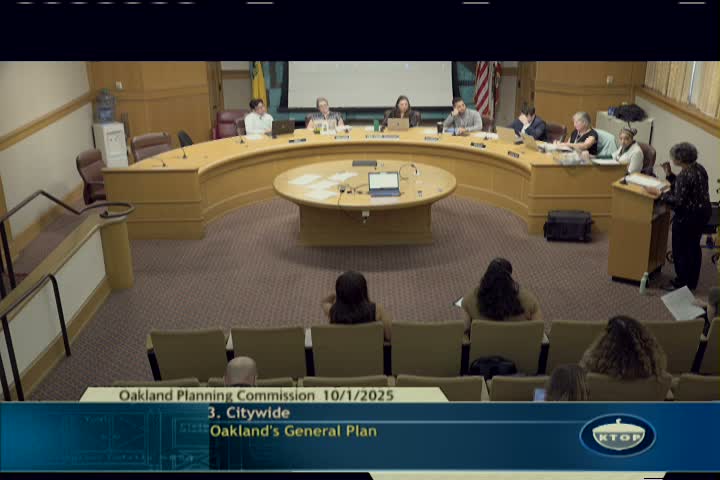
Oakland Planning Commission members on Oct. 1 provided consolidated feedback to staff on Phase 2 of the city’s general plan update, expressing broad support for options that emphasize neighborhood centers and transit corridors while asking staff to develop a public lands policy, funding strategies and objective noise‑measurement approaches.
Project manager Lakshmi Raj Gopalan and planners described three broad options under consideration: Option A, a "City of Neighborhoods" that spreads growth across mixed‑use neighborhood centers; Option B, "Connected Corridors and Gateways" that concentrates growth along major transit corridors; and Option C, a "Midtown Waterfront District" that would focus growth and waterfront access in a concentrated waterfront district. Staff emphasized these are high‑level options that can be mixed and that the draft land‑use framework is expected in early 2026.
Commissioners praised the project’s community engagement, including the Deeply Rooted youth fellows who have conducted outreach and amplified underrepresented voices. Several commissioners asked staff to incorporate a public lands policy to promote affordable housing (citing long‑term ground leases as an example), to analyze new funding sources including impact fees and a long‑term capital improvement plan, and to use updated, objective noise metrics in the noise element. Commissioner comments also requested that staff explain how major infrastructure possibilities — including a San Antonio transit hub and potential changes to I‑980 — will be evaluated in later drafts.
Staff said the options are intended as a starting point and that further analysis, interdepartmental coordination, and coordination with BART, Caltrans and regional agencies will be part of the draft land‑use framework. The commission voted to provide the consolidated comments heard at the meeting to the GPU team for incorporation into future materials.
Staff noted the next step will be a draft land‑use framework and element development, with additional public review and further commission recommendations before the plan moves to City Council.