Get Full Government Meeting Transcripts, Videos, & Alerts Forever!
Get email alerts on the Planning Code Amendments topic
No spam. Unsubscribe anytime.
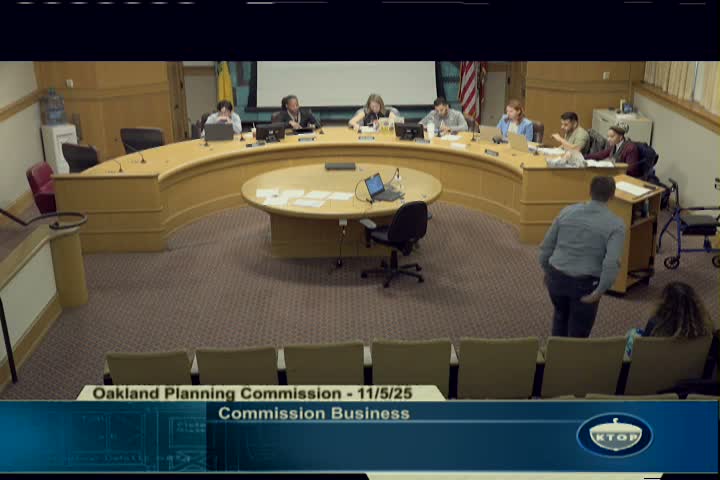
Oakland planning commission unanimously backs citywide code changes to streamline conditional-use permits
Summary
The Planning Commission voted unanimously to recommend City Council hold a hearing and adopt amendments to Title 17 that raise CUP thresholds, expand permitted ground-floor uses, add small-project design review and require performance plans (like operational noise plans) for some venues; staff expects mid‑February implementation after council action.
The Oakland Planning Commission voted unanimously to recommend the City Council conduct a public hearing and adopt a package of citywide planning-code amendments intended to streamline conditional-use-permit (CUP) requirements, expand permitted ground-floor activities and shorten approval timelines.
Planner Timothy Green told commissioners the proposal aims to reduce barriers that “inhibit the opening of small and neighborhood serving businesses,” moving many uses from CUP review to permitted or minor‑CUP paths and adding small-project design review to handle supplemental plans such as pickup/drop-off management and operational noise plans. Staff said the proposal extends reforms piloted in the Broadway-Valdez downtown update to the entire city and would generally raise square-footage CUP thresholds by about 20–50 percent.
Why it matters: Staff and commissioners said the changes are intended to cut fees and processing time for small projects while preserving public review for higher‑impact proposals. Green used two staff examples during the presentation: a restaurant that previously paid more than $3,000 in planning fees and waited over two months for approval could, under the proposed rules, cost under $100 and be approved in roughly 10 days; a veterinary‑clinic expansion that previously took four months and charged more than $4,000 could likewise see significantly reduced time and cost under the new classifications.
Key provisions and safeguards - Thresholds: Group-assembly thresholds would generally require a CUP only at larger scales (roughly 10,000–15,000 square feet depending on zone). Projects under those thresholds that propose amplified sound would instead submit an operational noise plan as a performance standard. - Small-project design review: Staff proposed adding language to section 17.136.0.3 to require supplemental plans (for example, pickup/drop-off management or operational noise plans) when a use does not trigger a CUP but still needs targeted review. - Parks and open space: Many minor park facilities (pathways, kiosks, restrooms in most parks) would move to permitted or minor‑CUP review to reduce duplicative hearings; higher-impact amenities such as restaurants, water play features and alcohol sales would remain subject to major CUP and PRAC (Parks & Rec Advisory Commission) review. - Use classifications: The amendments would add or expand categories such as artist/artisan production and clarify ground-floor transparency requirements for certain medical and animal-care uses to balance storefront activation with sensitive operations.
Staff stressed enforcement links between planning approvals and building permits and said operational noise plans would measure property-line noise against existing city noise standards and propose mitigation (for example, soundproofing or entrance modifications). “The CUP approval process is often lengthy and expensive and affords a high level of discretion to city decision makers,” Green said during his presentation, arguing that performance standards can preserve safeguards without full CUP hearings for lower-impact proposals.
Commissioners asked about outreach, equity and tracking outcomes. Commissioner Alex Randolph urged proactive outreach and technical assistance for small and immigrant entrepreneurs and suggested partnerships with chambers and community‑based organizations in corridors such as East and West Oakland. Deputy Director Ed Menasci said staff are coordinating with the Public Information Office on messaging, are exploring public-facing dashboards to map zoning clearances and new businesses, and will evaluate whether targeted tracking of geographic benefits is feasible.
Procedure and next steps The commission accepted a minor staff modification to the report, then voted to recommend the City Council conduct a public hearing and, upon conclusion, adopt an ordinance amending Title 17 (including the added small-project design-review provisions). Staff said the item will go to CED on Nov. 18 and to the full City Council in December, with a planned 60‑day implementation period that would put the amendments into effect in mid‑February.
Votes at a glance - Motion to accept minor modifications to the staff report: moved by Chair Pro Tem Josie Aarons; seconded by Commissioner Alex Randolph; recorded unanimous yes votes (Commissioners Owen Lee, Alex Randolph, Maurice Robb, Chair Pro Tem Josie Aarons). - Motion to recommend City Council conduct a public hearing and adopt the ordinance amending Title 17 (with the small-project design-review additions): moved by Commissioner Alex Randolph; a second was recorded; the commission voted unanimously to pass the recommendation.
What remains unresolved Commissioners requested clearer public reporting on which neighborhoods benefit most from the reforms and a plan for periodic review of impacts (for example, annually or every few years). Staff said tracking and public dashboards are under consideration but may require additional data resources.
The Planning Commission closed the public hearing (no public speakers were recorded) and adjourned at 4:11 p.m.