Get Full Government Meeting Transcripts, Videos, & Alerts Forever!
Get email alerts on the Vision I980 topic
No spam. Unsubscribe anytime.
Caltrans updates Oakland planning commission on I‑980 study; removal scenario most favored by nearby respondents
Summary
Caltrans staff presented phase 1 of the Interstate 980 corridor study (Vision 980), outlining three scenarios—enhance, cover, remove—reporting that 68% of West Oakland survey respondents favored removal; phase 2 feasibility work is planned for 2026–27.
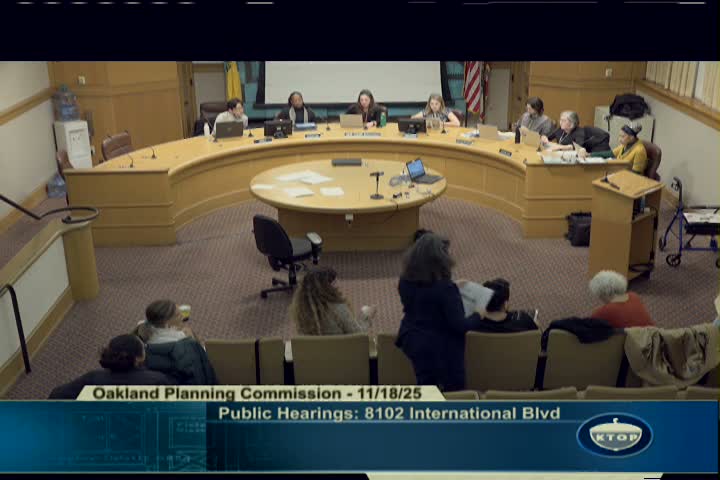
Caltrans told the Oakland Planning Commission Monday that phase 1 of the Interstate 980 corridor study (Vision 980) has identified three high-level scenarios—enhance, cover and remove—and that the study will move to a phase 2 feasibility and technical analysis in 2026–27.
Becky Frank, community planning branch chief for Caltrans District 4, said the study team sought community input and used an equity evaluation framework to assess how the scenarios meet study goals. Frank reported that in a round‑2 survey of about 1,900 people, 68% of West Oakland respondents ranked the remove scenario as their top choice; non‑West Oakland respondents favored removal at a lower rate (49%). She summarized the scenarios: "enhance" focuses on improving crossings without changing the freeway structure, "cover" would add a deck or cap to create new surface space (for parks or development), and "remove" would dismantle the facility and restore the street grid.
Frank said the consultant team applied the equity evaluation and that the remove scenario scored highest in the study’s pass/fail equity assessment (22 passes, 12 fails) compared with cover (20 passes, 14 fails) and enhance (14 passes, 20 fails). She emphasized that no decision has been made and that phase 2 will include more detailed traffic and feasibility analysis, conceptual cost estimates, and continued community engagement.
Commissioners asked whether land freed by removal could remain publicly owned and whether reparative policies for residents displaced during freeway construction were being considered. Frank said portions of Caltrans land could be relinquished to the city and noted that some jurisdictions have used strategies such as first right of return for displaced residents; she said phase 2 will analyze land-use opportunities and potential reparations strategies. On traffic impacts, Frank said new traffic counts were taken in September and that technical traffic modeling will be part of phase 2; she did not provide detailed traffic volumes at the meeting.
Frank also said the project team is coordinating with other initiatives and agencies, including BART and the regional Link 21 planning effort, by involving them on the project technical advisory committee. The final phase‑1 report will be published in 2025 on the project website; Caltrans said it plans community presentations on the final report in early 2026 and will continue public engagement into phase 2, which will examine feasibility, costs and implementation strategies.