Get Full Government Meeting Transcripts, Videos, & Alerts Forever!
Get email alerts on the Body Worn Cameras topic
No spam. Unsubscribe anytime.
Police commission advances revised body-worn camera policy to meet-and-confer
Summary
The San Francisco Police Commission voted to send revised Department General Order 10.11 on body-worn cameras to meet-and-confer after months of working-group negotiation; the policy narrows on-scene deactivation exemptions, adds a new activation circumstance for on-scene commands, and includes airport-specific MOU language. Commissioners and community lawyers debated redaction, discovery, and tactical deactivation safeguards.
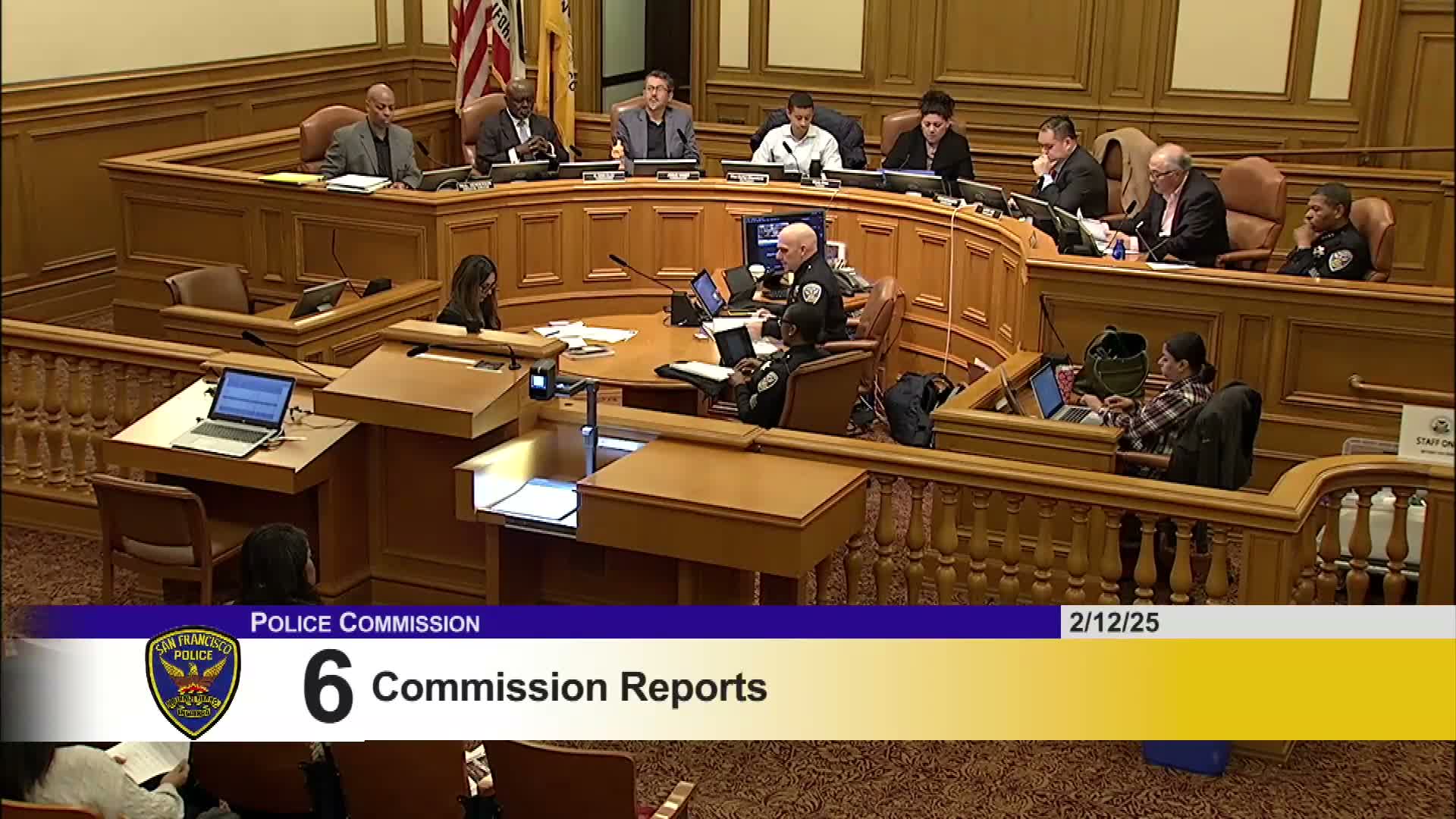
The San Francisco Police Commission voted Feb. 12 to forward a revised Department General Order (DGO 10.11) on body-worn cameras (BWC) to meet-and-confer with affected bargaining units after extended discussion among commissioners, the police department and community stakeholders. The motion passed with six affirmative votes.
The revision narrows the department's list of limited exemptions permitting BWC deactivation to a defined set of sensitive tactical situations and adds a new activation circumstance (item 15) requiring activation to record "issuing commands and briefing while on scene during an active incident," language that Commissioner Benedicto read into the record as a late edit. The chief and policy staff told the commission that the policy also includes a specific procedure for airport operations and anticipates a separate airport MOU to govern use and sharing of BWC footage at San Francisco International Airport.
Supporters described the DGO as the product of a year-long working-group process that brought together the department, the Bar Association, the Public Defender's Office and community groups. Brian Cox of the Public Defender's Office and Julie Tron of the Bar Association both addressed the commission in public comment, thanking the working group and urging robust redaction procedures and judicial protections in discovery. DPA staff said the new language on who may authorize tactical deactivation was substantially improved by input from oversight and community stakeholders.
Commissioners pressed the department on a practical question at the heart of their debate: whether to allow officers to turn cameras off in the field to avoid recording sensitive tactics or to keep them running and rely on post-incident redaction. Chief Scott said the department sought a narrow deactivation allowance for rare operational needs (for example, explosive ordnance responses or active-attacker incidents) and agreed the highest-ranking on-scene incident commander must authorize any deactivation. Chief Scott also acknowledged that if a camera captured sensitive tactical information and the footage was subject to discovery, the unredacted footage would need to be turned over to defense counsel, after which the department and prosecutors could ask a judge to redact sensitive elements under established evidentiary procedures.
The policy also tightens language about initial interviews after an officer-involved use of force: instead of requiring a summary, the DGO instructs the involved member to "describe the actions" they took and their perceptions of the incident, including what they saw, heard, felt, believed and experienced.
The vote sends the revised DGO to meet-and-confer with labor partners; commissioners said they will continue to monitor implementation and the effect of any related airport agreement. The commission recorded no amendments at passage; the chief's office will return with materials required by the meet-and-confer process.
Next steps: DGO 10.11 will proceed through meet-and-confer and, if settled, return to the commission for final consideration and potential adoption.