Get Full Government Meeting Transcripts, Videos, & Alerts Forever!
Get email alerts on the Public Safety Enforcement topic
No spam. Unsubscribe anytime.
SFPD reports drop in Part 1 crimes, details large enforcement action at Market and Van Ness
Summary
Chief Scott told the commission SFPD is down roughly 30% in Part 1 crimes year-to-date and described a March mass-enforcement operation at Market and Van Ness that used drone surveillance and multi-agency teams, resulting in 41 arrests; commissioners pressed about DA charging and evaluation metrics.
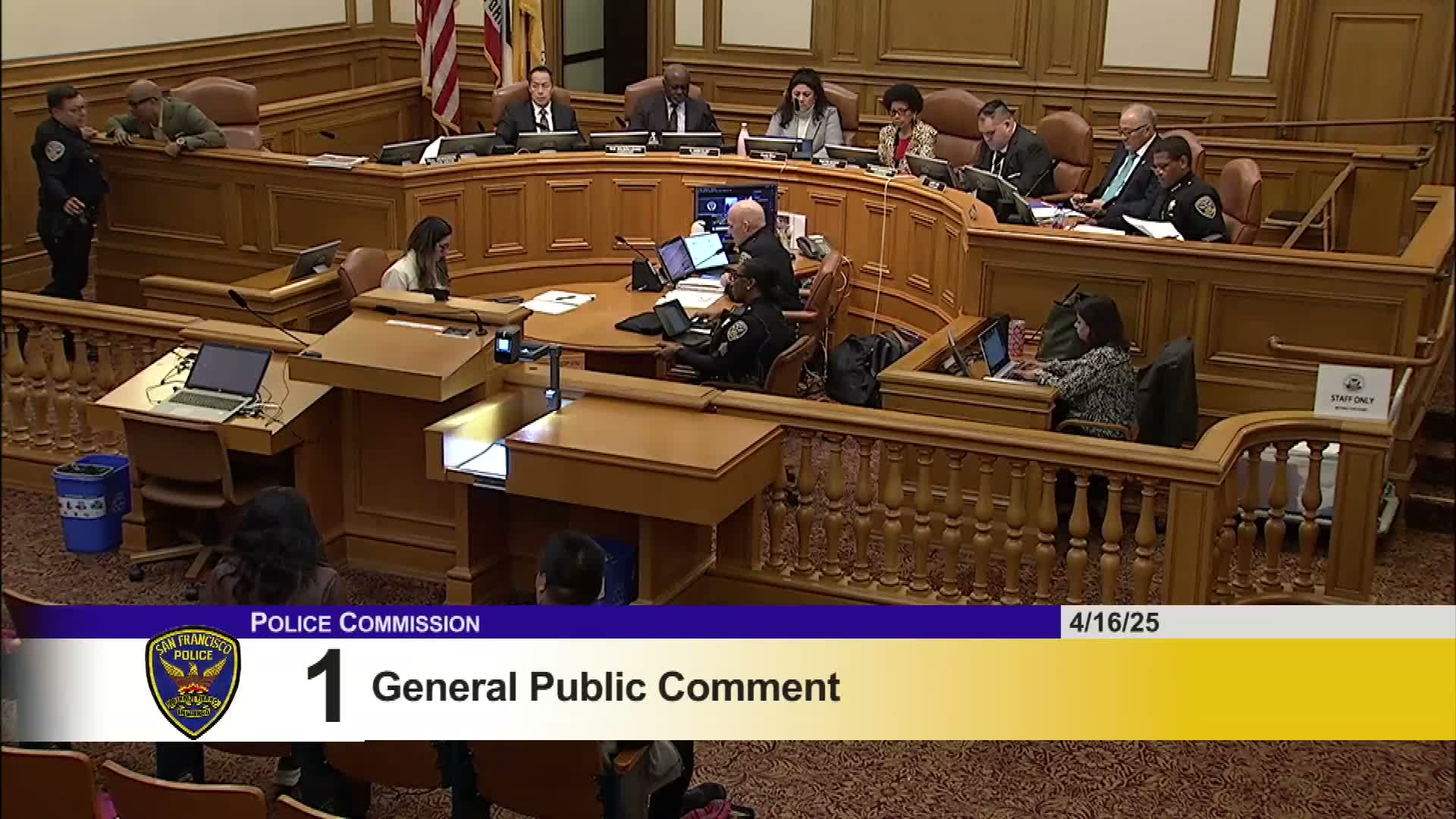
San Francisco Police Department Chief Scott told the Police Commission on April 16 that the city is seeing a year-to-date reduction of about 30% in Part 1 crimes, with a 15% drop in violent crime and a 32% decline in property crime.
The chief said homicides stood at five for the year compared with nine during the same period last year, while shootings were up modestly. "Weare still down 30% in Part 1 crimes," he said. He described one recent homicide in the Tenderloin on April 14 and outlined ongoing investigations.
Chief Scott spent the bulk of his presentation outlining a large, coordinated enforcement operation at Market and Van Ness, which included multi-day surveillance, drone footage and a targeted interdiction. "From the drone footage I could see where people were congregating," he said, describing visible indicators of drug use and apparent hand-to-hand transactions. He said officers arrested 41 people from an estimated crowd of more than 90, seized about 37 items of paraphernalia and provided medical care at the scene for people who appeared near overdose.
Commissioners asked why many arrests do not result in charging. The chief explained that arrest standards (reasonable suspicion, probable cause) differ from a prosecutors charging standard (proof beyond a reasonable doubt) and said SFPD is continuing to coordinate with the District Attorneys office to provide evidence that meets charging thresholds. "We oftentimes will make arrests because we have probable cause to make the arrest," he said, adding that the DA evaluates whether cases can be proved at trial.
Members pressed for metrics to evaluate operations. Commissioner questions sought stop/arrest data and third-party validations; the chief said stop data should be recoverable from the officers who conducted the operations and that the department is meeting with the DA and using analytical partners to target repeat offenders.
Community organizations and business representatives gave public comment endorsing the operations as part of a multi-agency approach. The Civic Center Community Benefit District and Tenderloin Community Benefit District said visible improvements at Market & Van Ness and UN Plaza justified continued large-scale and smaller surge operations.
The chief said the department will continue multi-agency work including public health partnerships and environmental changes such as lighting and pedestrian improvements to sustain results. "When we go, when we're not there, all those problems come right back," he said, arguing for consistent deployment and complementary services.
The commission did not take formal action on operations at the meeting but requested additional data and follow-up briefings to evaluate outcomes and coordination with the District Attorney's Office.