Get Full Government Meeting Transcripts, Videos, & Alerts Forever!
Get email alerts on the Dpa Case Management topic
No spam. Unsubscribe anytime.
DPA reports fewer long-running investigations, flags late document production and wins national audit award
Summary
DPA Executive Director Paul Henderson told the Police Commission the average number of cases exceeding 270 days dropped from about six in 2023 to about two in 2025, but quarterly document noncompliance rose to 17% in Q4 2024; DPA also highlighted a national Knighton award for its stop-data audit.
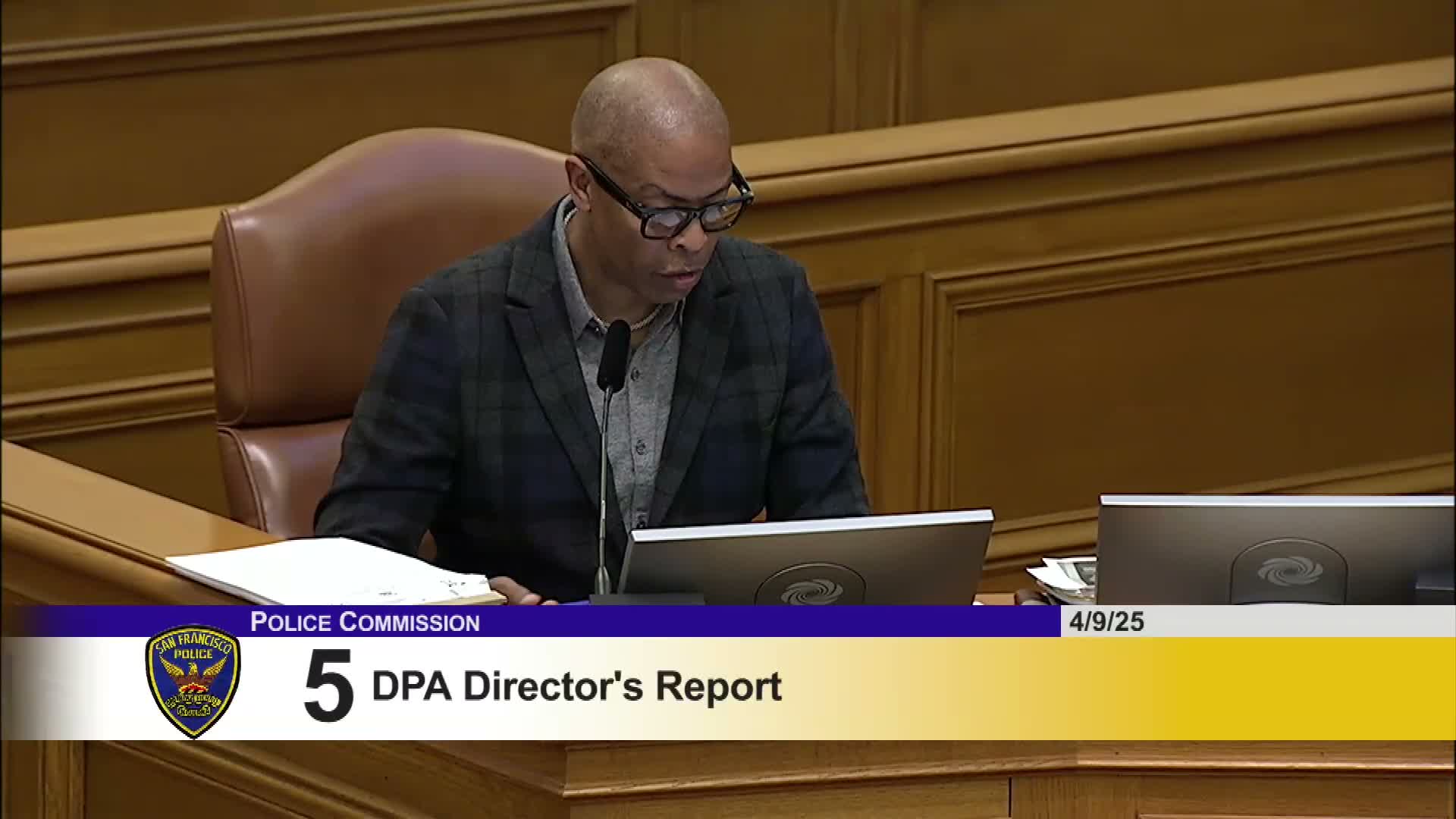
DPA Executive Director Paul Henderson told the San Francisco Police Commission on April 9 that the office has reduced the average number of investigations exceeding the 270‑day mark from roughly six in 2023 to about two in 2025, while describing a persistent problem with late document production from SFPD.
Henderson said one policy‑failure matter he labeled “case x” was not subject to the same internal 3304 deadline and that, after interviews and evidence collection, DPA determined the matter was not sustainable. He said SFPD requested extensions and later produced documents only after DPA followed up with noncompliance letters.
"We have reduced the number of cases exceeding the 270‑day mark from an average of 6 in 2023 to an average of just 2 in 2025," Henderson said. He also noted the quarter‑to‑quarter change flagged in DPA's document protocol report: SFPD was late returning about 6.5% of DPA's requests for the first three quarters of 2024, but that jumped to 17% in Q4 2024.
Henderson emphasized that policy‑failure cases are treated differently in internal deadlines but still receive full investigative work, including interviews of department subject‑matter experts and named officers. He said some sustained investigations approaching reporting deadlines are prioritized to meet statutory and internal timetables.
Henderson also highlighted audit work. He said DPA staff member Steve Flaherty received the 2024 Knighton award from the Association of Local Government Auditors for DPA’s stop‑data audit and noted that DPA has won multiple Knighton awards in recent years. "The judges this year found the audit to be well executed and impactful," Henderson said, adding that DPA will continue to present and share its audit approach nationally.
Henderson described DPA’s intern cohort and listed projects that include summarizing body‑worn camera video, drafting summary reports and conducting policy research. He said the office opened 15 new investigations and closed nine since the last commission meeting, and that 15 investigations remained open beyond 270 days (14 of those described in his remarks with an unclear status in the transcript). He added that 93 DPA cases were pending with the chief’s office and two with the commission.
The commission pressed for follow‑up detail on the Q4 spike in late document production and asked Henderson and Chief Scott to report back next week with trend data and whether the case‑specific delays were anomalous. Henderson agreed to an offline discussion on the specific case and to coordinate with the chief on systemic fixes and technology solutions to improve timely access to information.
The commission did not take formal action on these updates but asked for follow‑up reports and indicated interest in implementing audit recommendations.
Next steps: Henderson and Chief Scott will review the Q4 document‑production spike and report findings to the DPA liaison on the commission; commissioners asked that results be agendized for a future meeting.