Get Full Government Meeting Transcripts, Videos, & Alerts Forever!
Get email alerts on the Commission Roundup topic
No spam. Unsubscribe anytime.
Police Commission reviews crime trends, CIT expansion, Benchmark EIS fixes and language-access updates; several motions pass
Summary
At its May meeting the San Francisco Police Commission received the chief's weekly crime report, heard the CIT annual report and updates on the Early Intervention System's transition to Benchmark and the SFPD's language-access work, and approved a revised community policing DGO for meet-and-confer along with routine consent items.
The San Francisco Police Commission on Wednesday heard the SFPD's weekly report and multiple presentations on oversight and programs, then approved several procedural motions including sending a revised community-policing Department General Order (DGO 1.08) to meet-and-confer.
Chief Bill Scott opened the substantive portion of the meeting with a weekly report saying the city is "27% below where we were this time last year" in overall crime, driven primarily by reductions in property and violent crime. Scott gave specific operational figures: 366 guns seized year-to-date compared with 436 at the same point last year and 41 ghost guns seized this year compared with 40 last year. He described several major incidents under investigation, including a homicide near Columbus Avenue and North Point where a suspect later turned himself in.
The commission received a report from Lt. Donald Anderson on the Crisis Intervention Team (CIT). Anderson said the CIT ran two training course lengths (a 40-hour and a 10-hour option), that 72% of the agency is CIT certified (as reported), and that the CIT's staffing increased from four to eight officers. Anderson described new partnerships with the Department of Public Health and the San Francisco Fire Department community paramedics for co-responder and clinician support, and previewed a "care link" tool to let families and residents share triggers or preferences that would help officers respond more safely.
Sgt. Darren Naval presented results and a technical update on the Early Intervention System (EIS). For the fourth quarter the department generated 172 EIS alerts tied to 129 members; Tenderloin station generated the most indicator points. Naval described persistent data-integration problems migrating from AIM/crime data warehouse to the vendor Benchmark: data corruption and lost records required a manual review of roughly 14,000 officer records and produced hundreds of manual alerts. Naval said the department expects the new data pipeline to be completed by September to restore routine automated EIS alerts.
Policy and Public Affairs director Dr. Diana Arroche and Jorge Rivas from the Office of Civic Engagement and Immigrant Affairs briefed the commission on language access. They summarized DGO 5.2 and 5.23 requirements (free language assistance when requested or clearly needed and effective communication for deaf or hard-of-hearing individuals), reported expanded bilingual capacity and remote video interpretation options, and said a revised DGO 5.2 and a 2024 language-access report would be submitted to the commission in the coming weeks.
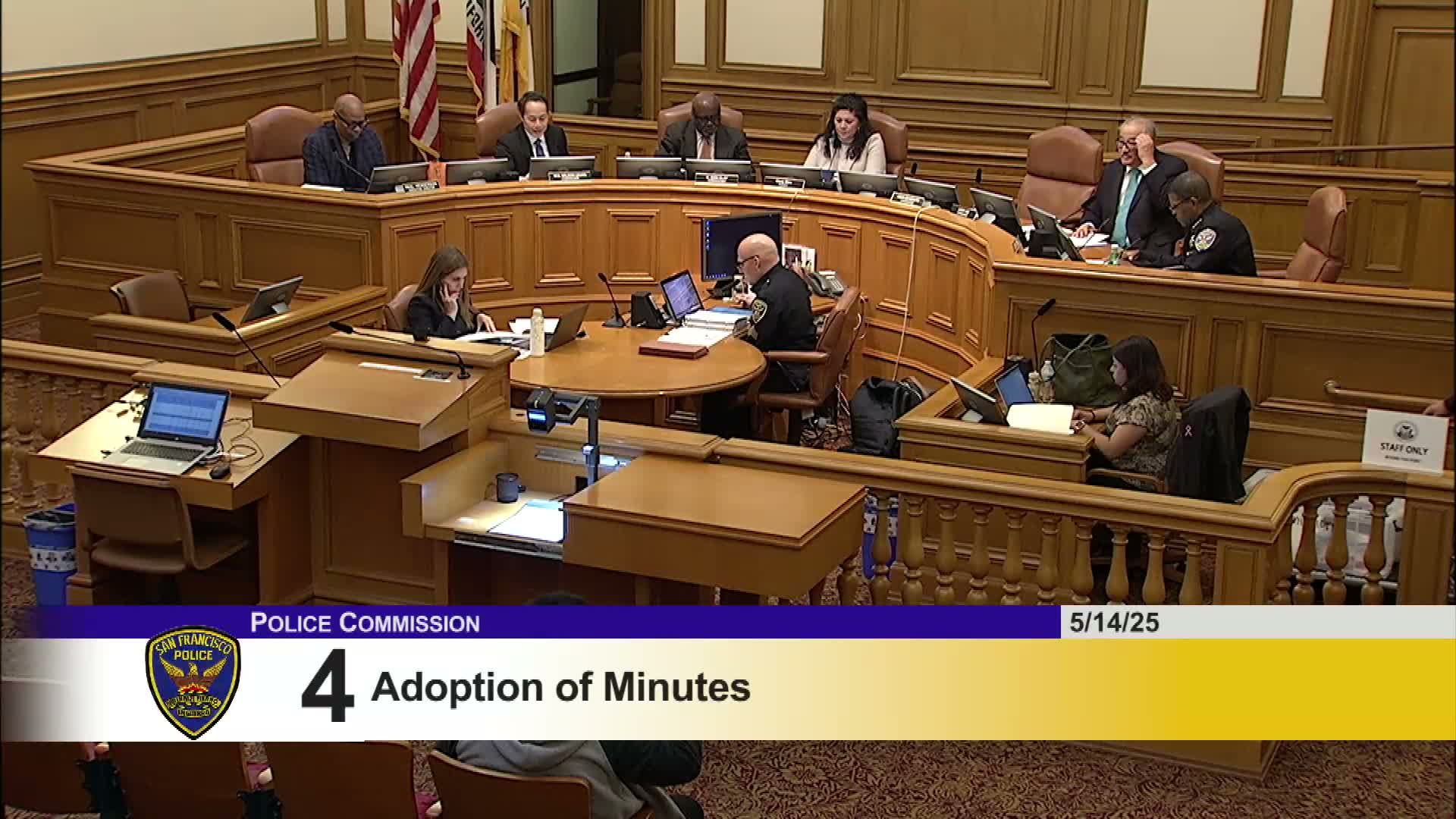
Votes at a glance: - Consent calendar (receive and file donation and quarterly reports): motion passed, recorded as 4 yes votes. - Adoption of minutes for April 2025: motion passed, recorded as 4 yes votes. - DGO 1.08 (community policing) sent to meet-and-confer: motion passed by roll call, 4 yes votes. - Vote to hold item 14 in closed session under Administrative Code Section 67.1(d): motion carried, 4 yes votes. - Motion not to disclose closed-session discussion (item 14): motion carried, 4 yes votes.
Public comment during the meeting included calls to investigate alleged deletions of emails to the commission and to expand clinician co-responder capacity. DPA Executive Director Paul Henderson and public commenters praised CIT work and urged continued investment in co-responder models.
What the commission asked for next: presenters said a more detailed 2024 language-access report would be delivered before mid-June and the department's technology division projected the EIS Benchmark pipeline will be completed by September. The commission moved several procedural items forward and closed the meeting to a private session for specified personnel or investigative matters.