
Board hears concerns over new Schools of Hope rules and co‑location provisions
Get AI-powered insights, summaries, and transcripts
Subscribe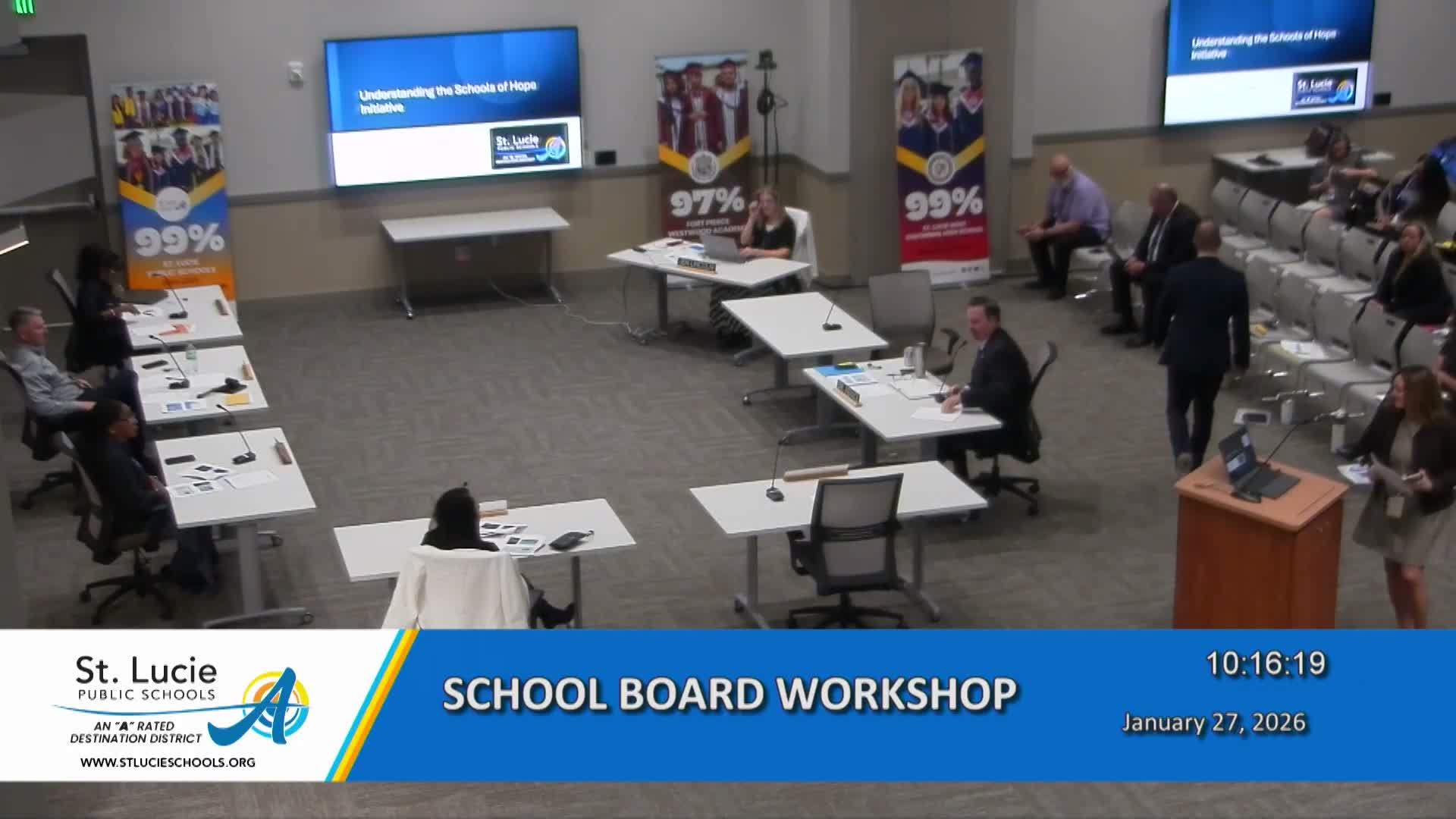
Summary
District staff warned recent state rule changes let School of Hope operators co‑locate in public schools and expand where they can locate, shifting facility and service costs to districts and raising safety, space and financial workload concerns.
Dr. Wilde, the district’s policy lead for charter and choice programs, told the board that changes to the Schools of Hope framework have expanded the program beyond its original intent and could impose new burdens on school districts.
"A school of hope can co locate in an existing operating school, and that has caused a lot of concern across the state," Dr. Wilde said, describing changes to the definition of "persistently low performing" and the addition of Opportunity Zones and district‑wide space availability as location criteria.
Wilde outlined the key changes: earlier rules required a School of Hope be within five miles of a persistently low‑performing school; new language allows locating within five miles of an Opportunity Zone or, if a district has available space, anywhere in the district. In 2025 the state added co‑location language that requires districts to provide facility‑related services (custodial, maintenance, safety, food and nursing services, and transportation) "at no cost to the school of hope operator," Wilde said. He warned the categorical and transportation dollars a charter receives are insufficient to cover the real costs and that co‑location creates operational and safety complexities, including shared common spaces and a seven‑day requirement for vacating space after the school year ends.
Board members asked practical questions about selection and denial authority. Wilde said districts have very limited grounds to deny a building notice — essentially "material impracticability," a term the statute uses but does not define — and that many notices targeted A‑, B‑ and C‑rated schools rather than only D/F schools. He reported that, statewide, operators issued hundreds of building notices on Nov. 11 and that many were later denied because the sender was not an approved School of Hope operator.
Superintendent Dr. Prince acknowledged the legislature likely did not intend the perceived unintended consequences and said district leaders are working with the local delegation and the Department of Education to seek clarifications and statutory fixes. Staff said the DOE planned to publish draft rule language for comment and that a State Board rule hearing was scheduled for Feb. 20 in Key West.
The board asked staff to monitor the rulemaking process and return with recommended local responses and advocacy points; the district does not currently have any Schools of Hope in operation.