Get Full Government Meeting Transcripts, Videos, & Alerts Forever!
Get email alerts on the Disaster Recovery topic
No spam. Unsubscribe anytime.
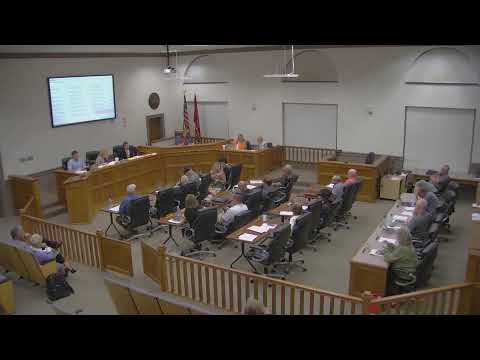
Speaker 8 gives year-in-review disaster update for Carter County; 42 projects in portal
Summary
Speaker 8 summarized a year of storm response in Carter County, describing debris operations, interagency coordination with FEMA/NRCS/TEMA, an estimated $180 million in public infrastructure damages, loan support from the state, and 42 portal projects with nine obligations by FEMA.
Speaker 8 delivered a detailed year-in-review disaster update for Carter County, describing emergency response, debris removal and the status of state and federal reimbursement efforts. "Right now, we have 42 projects in the portal," Speaker 8 told the commission, and described the county’s work to document damage, manage contractors and pursue FEMA and NRCS funding.
The presentation traced steps taken after the storm: early contracts and National Guard support (credited with about $450,000 in savings on debris operations), highway crews learning FEMA documentation procedures, establishment of temporary staging sites at the landfill, Hampton High School, Elk Mills and Roan Mountain, and extensive photo and load‑ticket records. Speaker 8 said debris contractors were released on Feb. 24 after weeks of winter hauling, and that county staff logged “tens of thousands” of load tickets and supporting documents to qualify projects for federal obligation.
Speaker 8 described interagency negotiations over waterway debris eligibility. NRCS initially limited eligibility to small segments (reported in the meeting as 1,100 feet), which Speaker 8 said would have left much debris uncollectable; the county and TEMA pressed the issue and the state assumed broader responsibility for waterway cleanup. Speaker 8 also said the county submitted an early rough estimate of publicly owned infrastructure damage of about $180,000,000 ("that is for infrastructure that is publicly owned by a county or a city," Speaker 8 emphasized).
On funding, Speaker 8 reported the county secured approximately $7,000,000 in a state loan to bridge debris costs while reimbursements were processed and that hazard mitigation work is under review, with about $1,200,000 currently in FEMA hazard-mitigation funding and additional mitigation requests approaching roughly $2,700,000 in potential funding. Speaker 8 outlined other milestones: engineering RFPs for bridge projects (Pogo 1, Pogo 2 and Long Hollow) are complete and contracts were expected to be posted soon, and the county moved to separate reimbursable versus non-reimbursable expenses to match FEMA/TEMA reimbursement windows.
Speaker 8 closed by summarizing project counts: 42 projects in the portal, nine projects described as "obligated" by FEMA, several pending obligation signatures, multiple projects in mitigation review and ongoing site inspections. The update concluded with an invitation for questions.
The commission moved on to the posted agenda after the update; Speaker 8 stood ready to answer follow-ups.