Get Full Government Meeting Transcripts, Videos, & Alerts Forever!
Get email alerts on the Commission Votes Roundup topic
No spam. Unsubscribe anytime.
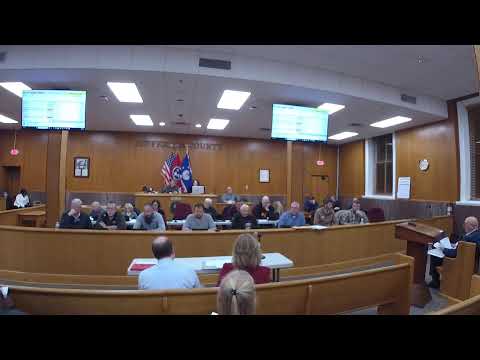
Jefferson County approves zoning and fiscal items; commission endorses state recall bill
Summary
At its January meeting the Jefferson County Commission approved a zoning amendment restricting certain I‑3 uses (data centers), rezoned a Highway 92 parcel, approved multiple budget amendments and surplus actions, and voted to recommend state recall legislation to the General Assembly (15–3).
Jefferson County commissioners at their January session approved a slate of zoning, fiscal and administrative measures including a zoning amendment on permitted I‑3 uses (data‑center/IT policy), a rezoning of a parcel on Highway 92, several budget amendments, and a resolution urging the state General Assembly to consider legislation enabling recall of local elected officials.
The commission unanimously approved Resolution 20‑25‑63 to amend the county’s zoning ordinance language on permitted and prohibited uses in the I‑3 district (data center/IT/AI uses), 18–0. Commissioners also approved Resolution 20‑25‑66 to rezone a parcel on Highway 92 from A‑1 to C‑2 by a 17–1 vote.
Budget amendments across funds were approved by voice or roll call, including a $9,000 general fund allocation to the Election Commission for mailings and postage, school and library reserve adjustments including a $50,000 reserve utilization item, acceptance of a public school security grant and other routine fund adjustments; the votes were recorded as unanimous where noted (18–0).
County Mayor Mark Potts told commissioners the county secured a SS4 safety grant for traffic and road data collection — “about $188,000 with a 20% match,” he said — to support long‑range transportation planning and traffic counts.
A report read on behalf of lobbyist David Veil summarized state real estate transfer tax legislation (identified in the read statement as SB 1080 / HB 649) that would return roughly 50% of proceeds to Jefferson County; the read summary estimated approximately $1,000,000 per year for county roads, capital projects and debt service if enacted and noted expanding legislative cosponsorship.
On policy advocacy, the commission debated Resolution 20‑26‑06, which asks the General Assembly to enact citizen‑driven recall authority for local officials. After a failed motion to table, the commission approved the resolution 15–3. Supporters said the resolution merely expresses support for state bills and does not change county practice; opponents said they needed more background information before taking a position.
Other actions: the commission declared decommissioned ambulances surplus (Resolution 20‑26‑02), approved an interlocal agreement with Jefferson City on rehabilitation of the Mossy Creek Wildlife Viewing Area (Resolution 20‑26‑04), approved an increase to the commercial solid‑waste tipping fee (Resolution 20‑26‑05), authorized donation of a K‑9 to a neighboring department (Resolution 20‑26‑07) and approved transfer of a vehicle to the Chancery Court Clerk (Resolution 20‑26‑08). Most of these routine items passed unanimously.
Votes at a glance:
Resolution 20‑25‑63 (I‑3 zoning uses — data centers): Passed 18–0. Resolution 20‑25‑66 (rezone parcel on Highway 92 A‑1 → C‑2): Passed 17–1. Resolution 20‑26‑01 (rezone parcel on Harrison Road A‑1 → C‑2): Denied 17–1 (covered separately). Resolution 20‑26‑02 (surplus ambulances): Passed 18–0. Resolution 20‑26‑04 (Mossy Creek interlocal): Passed 18–0. Resolution 20‑26‑05 (tipping fee increase): Passed 18–0. Resolution 20‑26‑06 (endorse state recall legislation): Passed 15–3. Resolution 20‑26‑07 (donate K‑9): Passed 18–0. Resolution 20‑26‑08 (transfer vehicle to Chancery Court Clerk): Passed 18–0.
What’s next: Staff and commissioners indicated the transportation grant will be followed by data collection and a subsequent multi‑year plan; the recall legislation will proceed at the state level if sponsors advance bills in the General Assembly.