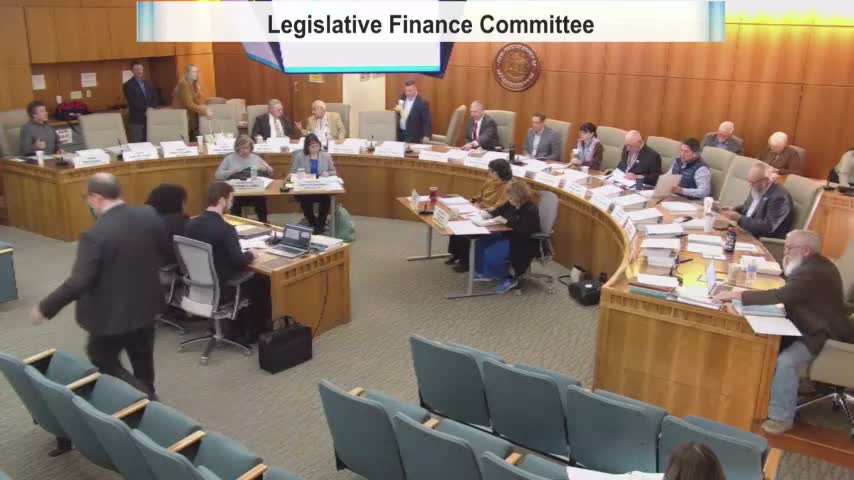
LFC provides January status update on SNAP evaluation as HR 1 raises state financial exposure

Legislative Finance Committee · January 19, 2026

Get AI-powered insights, summaries, and transcripts

Subscribe
AI-Generated Content: All content on this page was generated by AI to highlight key points from the meeting. For complete details and context, we recommend watching the full video. so we can fix them.

Summary

LFC staff gave a January status update on the full Supplemental Nutrition Assistance Program (SNAP) evaluation the legislature directed the office to complete by July 1, 2026, warning that recent federal changes (HR 1) increase New Mexico’s fiscal exposure if payment error rates remain high.

LFC analysts told the Legislative Finance Committee on Tuesday that recent federal changes to SNAP under HR 1 will increase New Mexico’s financial exposure and that the Legislature has directed LFC staff to complete a full program evaluation by July 1, 2026.

Alma Kasim, an LFC evaluator, opened the briefing by saying the January presentation was a status update and background for the full evaluation, which will examine SNAP administration, performance, and program integrity. "We're here today to provide that status update," Kasim said, noting the evaluation will focus on program performance, staffing and operations, and integrity measures including fraud and payment accuracy.

Clayton Lobaugh, LFC program staff, said New Mexico’s SNAP payment accuracy requires improvement and described how the federal auditing process translates payment-error rates into state costs. "New Mexico has a SNAP error-rate problem, that could result in millions of additional costs for the state," Lobaugh said, and explained the tiered penalty schedule under HR 1 that makes states liable for a share of direct benefit costs when payment-error rates remain above specified thresholds.

Lobaugh summarized the penalty tiers presented on slide 20: if a state’s error rate falls below 6% there is no direct-benefit penalty; higher ranges trigger progressive state shares of direct benefit costs. He also explained the two-stage audit used to calculate final error rates: a state sampling and review, followed by federal USDA review of roughly half of those audited cases.

Presenters gave data context: SNAP delivered roughly $1 billion in food benefits to about 460,000 New Mexicans in federal fiscal year 2024, and the state share of SNAP administration is increasing from 50% to 75%, which raises administrative costs borne by New Mexico. The team said pandemic-era waivers and eased recertification processes contributed to cost and participation spikes, and those changes likely played a role in recent increases to the state’s audited payment-error rate.

Committee members pressed LFC on specifics the evaluation will examine. Vice Chair Munoz and others asked for a line-item breakdown of the Income Support Division’s staffing and the $111 million cited for program administration; presenters said LFC will request detailed HCA data on FTE counts, technology investments, and reconciliations as part of the full evaluation. Senator Woods and others raised practical fraud-prevention questions — for example whether photographic ID on SNAP Electronic Benefit Transfer cards would reduce improper use — and Lobaugh pointed them to HCA’s Office of Inspector General procedures and said the evaluation will review fraud prevention and investigation processes.

LFC staff also noted an observable subset of validated stolen-benefit reimbursements from a recent federal window: roughly 4,600 New Mexico SNAP households received federal replacement reimbursements totaling about $2.3 million between October 2022 and December 2024, primarily for card-skimming losses.

What happens next: LFC staff said they have formally initiated the program-evaluation process with HCA leadership, have requested data and are scheduling interviews, and will provide a full program evaluation to the Legislature by July 1, 2026, per the legislative directive. Committee members asked LFC to return with more granular staff and cost breakdowns, retailer participation details, and examples of state-level approaches other jurisdictions use to mitigate error rates.