Get Full Government Meeting Transcripts, Videos, & Alerts Forever!
Get email alerts on the Ab202 Veterans Education topic
No spam. Unsubscribe anytime.
Guam senators debate AB 202 tuition-waiver bill; Perez amendments seek residency, service and reporting rules
Summary
Senator Perez offered several amendments to AB 202 (Guam Veterans Higher Education Benefits Act) to tighten residency definition, require a limited period of employment or repayment, and add annual reporting of beneficiaries and tuition waived; the floor adopted some definitional edits but multiple Perez amendments failed after objections.
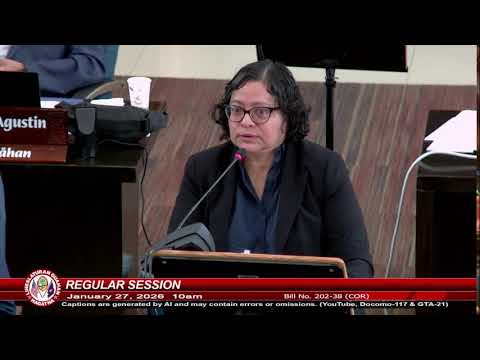
Guam senators spent the morning floor session debating AB 202, a proposed bill to provide local tuition waivers for veterans and certain dependents, and considered a string of amendments from Senator Perez aimed at narrowing eligibility and increasing program accountability.
Senator Perez opened by proposing a tightened residency definition: "qualifying veteran means a person who at the time of entry into the US armed forces was a resident of Guam and officially declared Guam as their home of record," she said, arguing the change would prevent opening eligibility to newly relocating military personnel and creating an "unfunded mandate." The presiding officer read the amendment (AB202, page 3, lines 12–15) and recorded no objections; that definitional change was ordered.
Perez then sought to add a definition of "tuition paying student" to clarify that waivers supplement, not supplant, federal benefits and to preserve seats for older students ("Manumco," age 55+). She next proposed a service-or-repayment provision initially framed as two years of service for every academic year of waiver received but withdrew that version and presented a revised cap: required service equal to program length but not to exceed two years, or the option to repay the government. "We have to be frugal," Perez said, urging a local return on limited taxpayer dollars. After floor debate and an objection, the revised service amendment failed on a recorded hand vote.
Accountability measures were a recurring theme. Perez proposed expanding reporting requirements so the executing agency must "submit a report to the Legislature no later than 90 days after the end of each academic year" detailing beneficiaries served, credit hours exempted, credits failed or withdrawn, repayments received, degrees enrolled and the calculated value of tuition waived. Supporters said the additional data would let lawmakers track program cost and target workforce needs; one senator cited committee testimony that these benefits "could run as high as $1,200,000." That reporting amendment advanced in floor discussion and drew support in comments.
Several equity and prioritization amendments were also debated and rejected. Perez proposed that some seats be set aside for civilian legal residents with disabilities and for low-to-moderate-income residents who have exhausted other aid; opponents argued those provisions were not germane to a veterans-focused bill and should be pursued as separate legislation. Perez also proposed prioritizing beneficiaries enrolled in commission-designated critical workforce shortage fields (for example, nursing, education and engineering); that amendment failed after objections.
Floor debate repeatedly returned to two central tensions: protecting limited local funds for returning residents and veterans while avoiding policies that could unintentionally exclude disabled veterans or impose burdensome certification steps. Opponents warned that requiring stricter limits—such as barring coverage for repeated courses beyond one additional attempt—could endorse "state-sponsored mediocrity" if left unchecked, while supporters said guarding against repeated failures protects scarce dollars and maintains academic standards.
On verification, Perez asked that applicants provide documentation proving they had exhausted federal veterans' educational benefits prior to receiving the local waiver. Critics said university financial aid offices already certify federal benefits and that requiring veterans to obtain extra VA paperwork could create an unnecessary roadblock; proponents replied that documentation brings accountability and reduces potential fraud. That amendment was objected to on the floor and subsequently failed.
By midday the chamber had adopted or ordered certain definitional and procedural edits but rejected multiple substantive amendments proposed by Perez. The Senate recessed for lunch at about 12:12 p.m., with consideration of further amendments to resume at 2 p.m.
What happens next: The bill remains under active floor consideration. Sponsors and opponents signaled plans to either rework contested provisions in separate legislation or refine language before additional floor votes when the session reconvenes.