Get Full Government Meeting Transcripts, Videos, & Alerts Forever!
Get email alerts on the Economic Development topic
No spam. Unsubscribe anytime.
EDD asks Legislature for $50M quantum match and $20M for site readiness; announces Mantis Space relocation to New Mexico
Summary
The Economic Development Department asked appropriators to approve a $50 million DARPA-match for quantum efforts and $20 million for site-readiness work, highlighted recent SIC-backed investments and announced Mantis Space's move to Albuquerque; legislators pressed EDD on community engagement, workforce pipelines and fund balances.
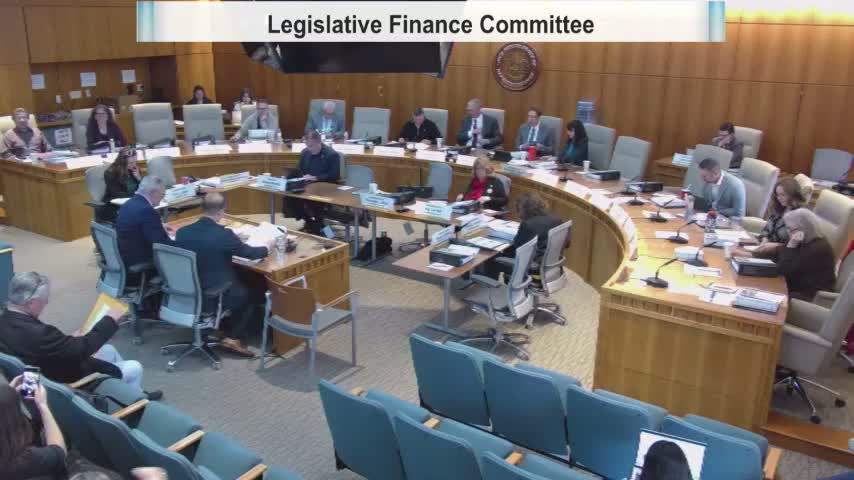
Rob Black, speaking for the New Mexico Economic Development Department, urged the Legislative Finance Committee to back a set of special appropriations aimed at converting recent deal momentum into long-term jobs and tax revenue. "We are number 1 in the country today for family income growth," Rob Black said, and asked for targeted funds to match federal dollars and ready sites for industrial investment.
Why it matters: EDD told the committee it has helped land major projects tied to the State Investment Council's venture strategy and is seeking a four-year DARPA match to accelerate a quantum hub, plus capital to make 47 characterized sites fully shovel-ready. EDD estimates the combined tax revenue from three headline projects could generate hundreds of millions in recurring state revenue over the next decade.
What EDD asked for and announced: Black described three headline priorities: a roughly $50 million state match to leverage DARPA and other federal quantum investments; $20 million for expanded site characterization and site-readiness work; and incremental funding increases for LITA and JTIP workforce incentives. He also announced a newly publicized deal: "Mantis Space," a Georgia-based company, will relocate headquarters and R&D work to Albuquerque. "We are asking for $20,000,000 in additional funds to help support those closing funds that help us really close those big deals," Black said.
Details and context: The department pointed to recent wins—Pacific Fusion, Project Jupiter and Castilian Hypersonics—and said that the State Investment Council's venture fund approach has created unique deal flow. Black tied the quantum ask to DARPA benchmarking and federal matches and said the state has already invested in a Quantum Innovation Hub and related initiatives. He described an enterprise site-mapping tool (procured through GIS WebTech) that will host site metrics for 47 characterized locations and said it is licensed on an enterprise basis so cost does not scale per site.
Pushback and oversight questions: Legislators probed adequacy and timing. Senator Padilla asked whether $50 million is enough for quantum and cautioned about competition from larger states; Black said the request is intended as a targeted match and to catalyze additional federal and private investment. Representative Garrett and others raised concerns about local public engagement, saying some projects did more community outreach than others. "Project Jupiter had five community meetings prior to the county meeting," Black responded, adding that outreach and confidentiality tensions are inherent to competitive site recruitment.
Budget clarity: Deputy Secretary Isaac Romero reported the LITA fund balance as roughly $21.7 million unencumbered, with pre-encumbrances and existing encumbrances for current projects. EDD asked for incremental increases to LITA and JTIP to sustain recruitment and training efforts.
Next steps: Committee members requested follow-up documentation on the quantum matching plan, the enterprise license terms for the site tool, and how tribal and local community site nominations are being handled. EDD said it will coordinate with Legislative Finance staff and provide additional budget details.
Ending: The committee moved from presentation to an extended Q&A; no formal appropriations were voted on at this hearing.