Get Full Government Meeting Transcripts, Videos, & Alerts Forever!
Get email alerts on the Service Animal Program topic
No spam. Unsubscribe anytime.
Subcommittee approves Maryland Disability Service Animal Program with $25,000 appropriation and staffing contingency
Summary
The subcommittee passed Senate Bill 157 and the corresponding House Bill 384 as amended to establish a Maryland Disability Service Animal Program administered by the Department of Disabilities, require MDOD to select nonprofit training entities, create a program fund with a $25,000 annual appropriation, and make the act contingent on MDOD certifying sufficient staff (with a 1.5‑year sunset if staffing is not met).
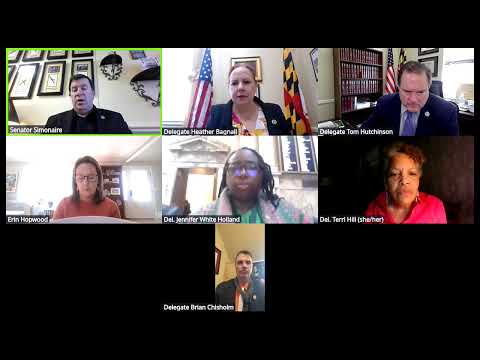
The Public Health and Minority Health Disparities Subcommittee unanimously adopted amendments and advanced Senate Bill 157 and the corresponding House Bill 384 to establish the Maryland Disability Service Animal Program in the Department of Disabilities (MDOD).
Erin, a committee staffer, said the reprint incorporates proposed amendments that streamline program requirements to reduce the fiscal note. The program would require MDOD to select at least one nonprofit training entity that meets specified qualifications to pair eligible state residents with disabilities with appropriate service animals. A Maryland Disability Service Animal Program fund would pay the nonprofit training entity and cover administration. The reprint limits an "eligible individual" to a state resident with a disability and removes a prior requirement that MDOD actively refer every inquiring individual; instead MDOD must select one or more qualified nonprofit training entities to participate.
Erin also summarized funding language: for each fiscal year the governor must include an appropriation of $25,000 to the fund, and the act is contingent on MDOD certifying it has sufficient staff to administer the program; if MDOD does not certify sufficient staffing after 1½ years the act sunsets.
Senator Simon Ayre, the bill sponsor, said the changes aim to lower the fiscal note and start the program small, modeled on the veterans' program. "The intent is to start small, get it working like we did with the veterans program, and if they wanna expand later, they can," he said. He added he had discussed the fiscal assumptions with Delegate Barnes and the department and said the department supports the amendments as drafted.
Delegate Hill questioned whether changing the language from referring individuals who inquire to selecting one or more nonprofit entities could create favoritism or exclude groups; Senator Ayre replied the department can select more than one provider over time and the change is intended to give MDOD flexibility rather than foreclose participation.
Members moved and seconded the amendments and the bill as amended; Chair Bagnell announced both Senate Bill 157 and House Bill 384 passed unanimously as amended. Erin said she would run the updated language by fiscal staff informally and flag the item for the Appropriations Committee if needed.
The measure establishes program structure, a small initial appropriation, and an administrative staffing contingency; further implementation details and expansion would depend on MDOD staffing decisions and future appropriations.