Get Full Government Meeting Transcripts, Videos, & Alerts Forever!
Get email alerts on the Nursing Home Inspections topic
No spam. Unsubscribe anytime.
Subcommittee allows counties to augment state nursing‑home surveys; HB 429, SB 376 pass unanimously
Summary
The Insurance and Pharmaceutical Subcommittee approved amendments to House Bill 429 and amended Senate Bill 376 to let counties hire inspectors to augment state nursing‑home surveys when the state is six months or more behind federal timeliness standards; the bills passed unanimously after committee discussion on data reporting and CMS tiering.
The Insurance and Pharmaceutical Subcommittee of the Health and Government Operations Committee on Wednesday approved amendments to House Bill 429 and amended Senate Bill 376 to allow counties to augment state nursing‑home survey teams when the Department of Health falls six months or more behind federal survey timeliness standards.
The measures, which the committee approved unanimously, require the Secretary of Health, on a county's request, to delegate authority so a county may augment state nursing‑home survey staff using county funds. "The department will have 45 days to initiate an MOU and develop a plan on how to implement the augmentation of staff," Lisa (Department of Health staff) told the committee during the bill summary.
Why it matters: committee members said counties have experienced delayed state inspections and sought a way to ensure timely reviews without removing all survey authority from the state. Chair (Insurance and Pharmaceutical Subcommittee) said the Office of Health Care Quality (OHCQ) has been delinquent on surveys for years and noted steps the agency has taken to catch up, including new hires and process changes.
What the amendment does: if the department is six months or more behind the federal standard for conducting nursing‑home surveys, a county may request authority to augment state teams. The department must begin an MOU within 45 days and prepare an implementation plan; the MOU and plan cannot prevent a county that augments from progressing to the next CMS survey tier if CMS authorizes that advancement. The amendment also requires the department to report to the General Assembly if it enters an MOU and to provide biannual reports to area agencies on aging listing the number and dates of state surveys conducted in the county during the prior six months.
Committee discussion focused on data clarity and triggers. Leslie Frey, representing Montgomery County, asked whether the six‑month trigger would be applied county‑by‑county or to the department's statewide average. "Our assumption was that this is actually for our entire body of work," Dr. Kalyanaraman (department official) said, adding the department could change to a county‑by‑county approach if the committee desired. Committee members agreed to add language requiring the department to include the statewide average completion rate in the reports so counties can determine when the augmentation option is available.
Operational context: the chair said OHCQ has reshaped operations over the last 18 months and is "literally catching up," with about 15 staff in training and roughly 45 performing surveys. The committee heard statewide counts: there are about 220 nursing homes in the state; the chair said Montgomery County had completed 23 of 34 surveys (about 68%) and Prince George's County had completed 9 of 19 (about 47%).
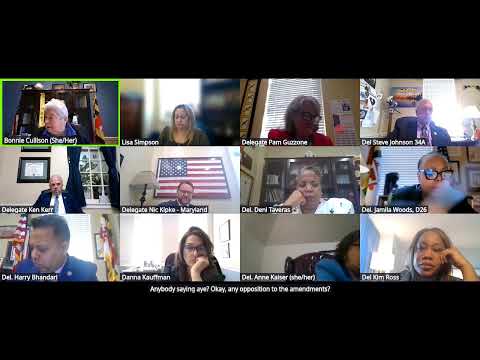
Vote and next steps: Dr. Kalyanaraman moved the amendments; a second was recorded and the committee approved the amendments and the bill as amended by voice vote with no recorded opposition. The committee then amended SB 376 to conform to HB 429 and passed that bill as amended, also unanimously. The chair said she would provide an update on SB 773 at a later date.
The bills now move forward as committee‑approved and amended; the committee record shows voice votes and no roll‑call tallies were recorded in the hearing transcript.