Get Full Government Meeting Transcripts, Videos, & Alerts Forever!
Get email alerts on the Cannabis Permit topic
No spam. Unsubscribe anytime.
Planning commission approves Embark retail cannabis store at 2400 Broad Street with added bike‑parking condition
Summary
The San Luis Obispo Planning Commission unanimously approved a conditional use permit for Embark San Luis Obispo to operate a cannabis retail storefront at 2400 Broad Street, adding a requirement that the applicant provide four bicycle parking spaces and meet city security and operations conditions.
The San Luis Obispo Planning Commission on the evening of the meeting approved a conditional use permit allowing Embark San Luis Obispo to open a cannabis retail storefront at 2400 Broad Street, with an added condition requiring four bicycle parking spaces.
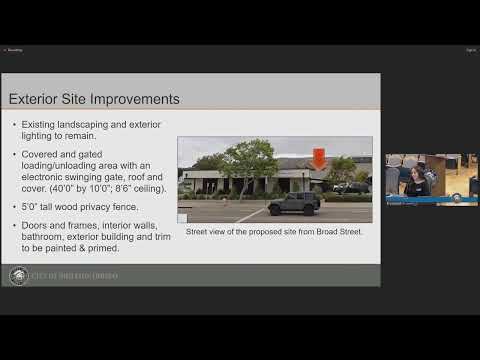
Staff presented the project and recommended approval. Ivana Gomez, the city’s cannabis business coordinator, told commissioners the 2,480‑square‑foot building sits on an 8,000‑square‑foot parcel in the Broad Street planning area and complies with the city’s cannabis overlay and buffer requirements. Gomez said the city limits retail storefront permits to three and that two storefronts already operate in the city; this site would become the third. She summarized required operations-plan elements including odor, noise and light management, employee training, community relations and a Police Department–approved security plan and noted the project is categorically exempt from California Environmental Quality Act review because it involves operation of an existing structure with negligible expansion of use.
Applicant representatives described the operation and neighborhood commitments. Devin Wardlow, vice president of public affairs for Embark, said the company operates more than a dozen California storefronts, works with the United Food and Commercial Workers union and directs 1% of gross revenue to community benefits allocated by a local advisory board. Wardlow described security measures including on‑site guards, off‑site monitoring and cameras and said the store layout includes a waiting lobby where staff will check identification before customers are buzzed into the sales area. “I like to share that going to Embark is somewhere that you'd feel comfortable bringing your grandma,” Wardlow said in the presentation.
Neighbors raised concerns about proximity and visible security. Property owner Bill Iserman spoke in support and said parking arrangements would be managed between properties. Resident Terry Canfield, who identified a Woodbridge address near the site, said they measured roughly 300 feet from their home to the storefront and said they had no objection to the store but opposed visible armed guards near a route children use to get to school, recounting a prior encounter in which they said they “was face to face with a person with a gun.” The applicant responded that security would comply with city code, that armed security would be positioned inside the building and that one guard would typically be in the lobby while another would be on the sales floor.
Commission questions focused on traffic, pedestrian safety and parking. Commissioners asked whether a nearby HAWK pedestrian signal and changes in tenant use would materially affect traffic; staff and the transportation division said the tenant change did not trigger a traffic study and did not identify a potentially significant increase in traffic. Staff also clarified that the city’s buffer rules govern distance from listed sensitive uses (schools, parks, licensed childcare and residentially zoned areas within the overlay) but do not extend to designated routes children take to school.
Motion and vote. A commissioner moved to approve staff’s recommendation for the conditional use permit. Another commissioner seconded and proposed, and the maker accepted, an amendment adding a condition to require four bicycle parking spaces (up from the applicant’s initially proposed two). The city attorney advised that on‑site conditions are within the commission’s zoning authority, the applicant signaled agreement on the record, and the commission voted 6–0 to approve the permit with the added condition. Commissioners who voted in favor and recorded their votes were Commissioner Tolley (Aye), Commissioner Jorgensen (Aye), Commissioner Flores (Aye), Commissioner Khan (Yes), Vice Chair Houghton (Yes) and Chair Justin Cooley (Yes).
What happens next. With the conditional use permit approved, Embark will be eligible to receive a final cannabis operator permit subject to payment of fees, completion of any outstanding background screenings and final building permits (signage, certificate of occupancy). Any future request to add delivery services would require a separate conditional use permit amendment.
Meeting notes. Staff previewed upcoming items including a Cal Poly abandonment/detachment matter and a 20‑unit affordable housing project by Smart Share Housing Solutions; the commission adjourned at the end of the meeting.