
Seguin residents, teachers press board over hundreds of library challenges; superintendent emphasizes process
Get AI-powered insights, summaries, and transcripts
Subscribe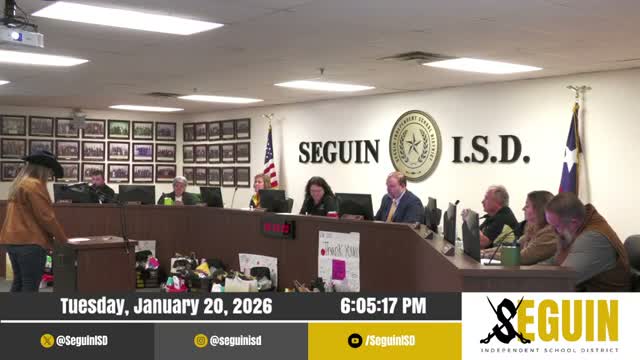
Summary
Ten public speakers addressed the board about library-material challenges under Senate Bill 13, with several parents saying the district ignored properly filed complaints and educators defending librarians’ professional review; Superintendent Dr. Lee said formal procedures were followed and that removed books are restricted from student access while under review.
Public comment at a Seguin ISD board meeting on Jan. 30 centered on contested library materials and how the district is handling formal challenges under state law.
Several residents and educators urged the board to accept all properly submitted challenges, temporarily remove challenged items from student access while reviews proceed, and publish a public tracker with dates and status updates. “I have personally submitted 169 formal challenges to books in our school libraries,” said Lynette Lennox, who said 28 challenges were accepted on a TEA form in mid-December while a subsequent submission of 141 challenges on Jan. 6 was refused as the wrong form. Lennox said she had retained attorney Jonathan Houlihan and accused the administration of spending taxpayer dollars to resist community requests.
Seguin High School teacher Tiffany Cunningham, who said she used Fahrenheit 451 in class, argued the law gives parental control without erasing access for other students. “Compliance does not require erasure,” Cunningham said, urging the board to trust professional librarians and reminding trustees that removing access can harm literacy and vulnerable students’ ability to find mirrors in literature.
Several speakers described real-world impacts when libraries close for review. “We couldn’t use the libraries. We couldn’t do tutoring,” said retired educator Patricia Buckley, recounting experiences in other districts where materials-review workloads delayed student services for months.
Civic-minded commenters and parents framed the debate in broader terms: “Libraries for some kids is actually like a sanctuary,” said Pedro Melendez, urging the board not to take that away.
Superintendent Dr. Lee responded during public comment to what he called inaccurate public narratives and emphasized the district’s procedures. “At no time was legal action threatened against any taxpayer,” Lee said. He reiterated that when library material is formally challenged, it is made unavailable to all students while the review committee considers the complaint, and he said the process requires properly completed forms and sufficient information so the review committee can act fairly.
Several commenters and a resident who identified himself as Mike Diaz urged specific actions the board could take to comply with the statute and improve transparency: log every properly submitted challenge, immediately restrict student access to challenged material while it is reviewed, publish a tracker listing received date, title and status, and place a formal SB13 compliance action on a future agenda so the board can set consistent procedures.
No board action on library policy or individual challenges was taken at this meeting. Trustees acknowledged the public comments and asked staff to track time and costs associated with processing challenges as part of board follow-up.
The board later moved to other agenda items and approved several actions, including the district’s strategic plan and routine financial items.