Get Full Government Meeting Transcripts, Videos, & Alerts Forever!
Get email alerts on the Station Area Planning topic
No spam. Unsubscribe anytime.
Staff outlines FrontRunner station-area plan and HB 462 requirements
Summary
City planning staff reviewed how House Bill 462 applies to FrontRunner station-area planning, explaining half-mile radii for commuter rail, objectives on housing and environment, and a corridor approach for clustered stations; staff said most existing plans already align and certification requires showing ongoing progress.
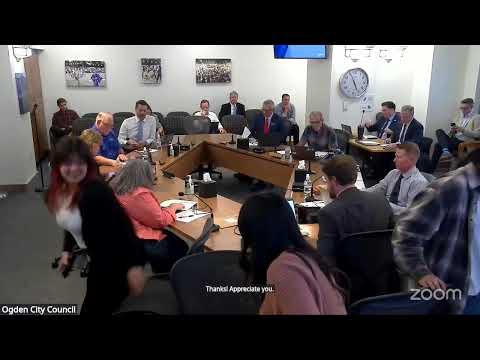
Planning staff presented the FrontRunner station-area plan and walked council members through the requirements of House Bill 462, which requires station-area plans for commuter rail and other fixed-guideway transit.
"So today, my focus is on the FrontRunner station area," Brandon said, introducing the objectives the law requires. Staff listed four statutory objectives: increase availability and affordability of housing, improve environmental conditions, strengthen transportation connections, and promote economic development.
Brandon explained the statutory mapping: commuter-rail and TRAX stations require a half-mile planning radius; dedicated bus rapid transit lanes require a quarter-mile radius. He told council members HB 462 triggers plans only where transit operates on a dedicated guideway or lane rather than at every stop.
Council members asked whether the city’s existing plans must be rewritten to comply. Brandon said they generally promote the same objectives and that certification focuses on demonstrating active progress rather than wholesale plan rewrites. On overlapping station areas, he said the city intends to treat proximate Ogden stations as a corridor on maps and that development in overlap areas could be counted for multiple stations.
A council member asked about incentives tied to the state’s Housing, Transit and Reinvestment Zones (HTRZ). Staff noted HTRZs have minimum density expectations (discussed in the meeting as 50 units per acre) and that local HTRZ designation could be a tool to encourage new housing near stations.
Brandon said the plan will return to the council for formal consideration and that he will present the finalized plan to the Wasatch Front Regional Council after local review. "So thank you," he added as the presentation concluded.
Next steps: staff will refine maps and corridor treatments and bring the station-area plan back to the council in the coming weeks for formal action and certification steps.