
Providers warn H.594 could worsen homelessness without more shelter capacity and services
Get AI-powered insights, summaries, and transcripts
Sign Up Free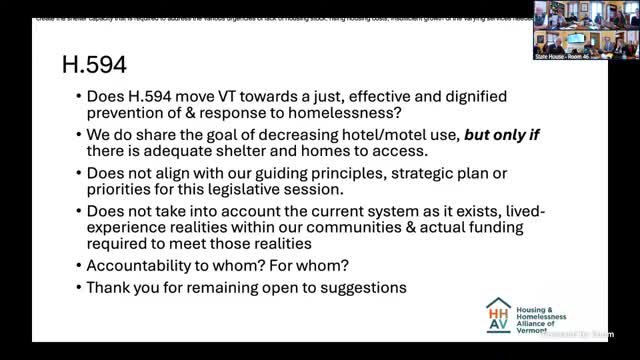
Summary
Statewide shelter and homeless‑service providers told the House committee that H.594 should not shrink motel or GA emergency capacity until non‑congregate units, staffed supportive housing and care coordinators are in place. Witnesses urged phased transitions, multiyear operating funds and better links to behavioral‑health services.
Providers from across Vermont urged the House Committee on Human Services to amend H.594 so reductions in General Assistance motel placements occur only after replacement shelter capacity and onsite supportive services are available.
In testimony, Chad Simmons, executive director of the Housing and Homelessness Alliance of Vermont, said HHAV "does not align" with the bill as drafted and recommended centering accountability around adequate shelter and person‑centered funding rather than punitive sanctions.
The sharpest warnings came from front‑line shelter operators. Jonathan Ferrell, executive director of the Committee on Temporary Shelter (COTS) in Burlington, told the committee that shelters must be trusted to require guest engagement "to the best of their ability" while remaining person‑centered, and that the General Assistance motel program "must be ramped down thoughtfully with other alternatives in its place." He said COTS operates a day station and program shelters that together served hundreds of unique clients in 2025 and described pilot efforts with recovery coaches and community health staff that helped individual guests access treatment and housing.
Rural providers told similar stories. Roxanne Crowley of the Bennington County Coalition for the Homeless said her county counted "over 400" unhoused people while the coalition operates only 16 individual beds and nine family units. She warned: "If this happens before we open more shelter units, it will once again increase homelessness in Bennington County and across Vermont." Crowley urged that capital funding be paired with guaranteed long‑term operating dollars and realistic timelines for rural development.
Julie Bond of Good Samaritan Haven (Washington County) and Angus Chaney of the Homeless Prevention Center (Rutland County) both urged keeping case management and clinical expertise embedded at the local level. Bond said "centralization further distances people in need from those who know them quite well" and asked that H.594 focus resources on fully funding local case management teams and operations rather than creating an additional layer of eligibility administration.
Speakers emphasized that many guests have co‑occurring mental‑health, substance‑use and medical needs and that referrals alone often fail. Jean Montross of HOPE described severe trauma and traumatic brain injury among clients and cautioned against prescriptive sanction regimes that assume linear compliance.
The committee pressed witnesses on implementation questions—how many beds are needed statewide, how long it takes to convert hotels into single‑room occupancy units with on‑site services, and whether regional specialized treatment sites are viable. Witnesses recommended a phased approach: preserve emergency motel capacity, invest in one‑to‑one replacement supportive units (including hotel conversions where feasible), and fund multiyear operating budgets and care coordination so shelters can transition people to permanent housing.
Next steps: the committee will continue testimony through the week and move to bill markup next week. The Agency of Human Services is scheduled to present commissioners and budget details at the committee hearing tomorrow.