
Mitch charter school says literacy gains and restorative justice cut discipline referrals by a third
Get AI-powered insights, summaries, and transcripts
Subscribe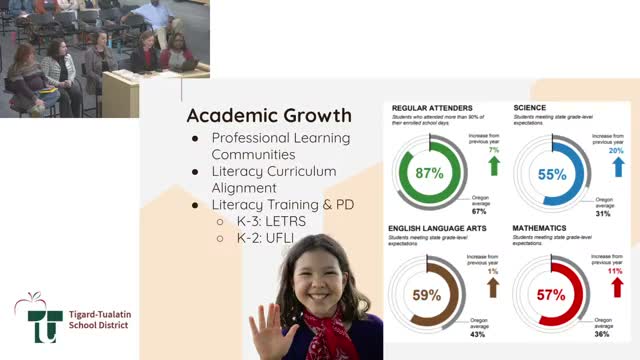
Summary
Mitch Charter School reported enrollment of 220 students, academic gains in ELA, math and science, a 33% drop in referral rates for underserved students after restorative‑justice work, a pilot summer literacy program that showed a 26% average improvement, and new nutrition and garden projects supported by local grants.
Mitch Charter School staff presented their annual report to the Tigard‑Tualatin School District board, highlighting academic recovery, restorative‑justice implementation and new student supports.
Principal Caitlin Blood told the board Mitch’s enrollment currently stands at about 220 students and is on budget; the school projects enrollment to rebound to approximately 235 next year. Blood said student performance in English language arts, math and science improved last year toward pre‑pandemic levels, and the school is investing in the science of reading and teacher training, with one‑third of grade‑level teachers completing or currently enrolled in LETRS coursework and adoption of the University of Florida Literacy Institute (UFLI) curriculum for K–2.
Mitch staff reported a free summer literacy pilot funded by the Oregon Early Literacy Grant that provided 45 hours of additional small‑group instruction at a 4:1 student‑teacher ratio. Reading specialist Leah Smith said pre/post assessments showed an average 26% increase in student performance for participants.
The school described restorative justice as a central strategy to reduce disproportionate disciplinary referrals. Staff said that, after one year of focused implementation and partnership with an organization called Just Outcomes, referral rates for underserved students dropped 33 percent. "It's far from perfect, and it's very messy," Blood said, but added the school is seeing more connection and empathy among students.
Nutrition and food‑security programs were also highlighted: the school began an on‑site nutrition program last fall (including a new salad bar), runs a backpack program in partnership with local food pantries, and started a family food pantry to support students amid reductions in federal and state funding.
Agriculture teacher Carmen Simons described a Tualatin Watershed Improvement Grant that will fund a 250‑foot native pollinator hedgerow to expand the outdoor classroom and support indigenous seed and cultural curricula.
Board members praised the presentation, asked for details about next steps for tiered restorative supports and acknowledged the visible progress in student literacy and school climate.
Next steps: staff plan continued rollout of tier 3 restorative interventions and to build on the summer literacy model for broader accessibility.