Get Full Government Meeting Transcripts, Videos, & Alerts Forever!
Get email alerts on the Water Quality topic
No spam. Unsubscribe anytime.
Lodi accepts triennial water-quality public-health goals report; utility says treatment meets state standards
Summary
The council accepted the city’s triennial public-health goals report on drinking-water constituents (2022–2024). Water Plant Superintendent Travis Kars said current treatment systems meet or exceed state and federal standards, the utility has had zero violations during his tenure, and the city is advancing treatment for PFAS and other contaminants where detected.
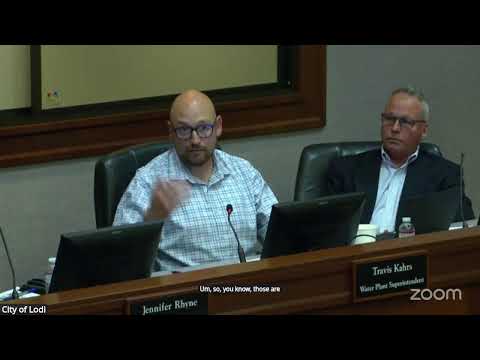
Travis Kars, Water Plant Superintendent for the City of Lodi, presented the city’s triennial public-health goals report on Oct. 1, describing monitoring, treatment and cost-estimate elements required under state guidance for substances detected above non-enforceable public-health goals.
Kars said the report covers data from 2022 through 2024 and draws on monitoring at 28 groundwater wells (about 55% of the city’s supply) and the surface water treatment facility (about 45%). He described the public-health-goal framework as a non-enforceable advisory level set by CalEPA and discussed treatment technologies and estimated costs: reverse osmosis to address arsenic where present, granular activated carbon (GAC) for volatile organic compounds and planned GAC treatment for a well with PFAS detection. The surface-water plant (completed in 2012) uses membrane filtration, chlorination and corrosion control.
"The current treatment systems that we've got in place are able to meet or exceed all state and federal drinking water standards, and are protective of public health," Kars told council. He also said the utility has had no water-quality violations or enforcement actions during his nearly 10-year tenure.
Kars explained that public-health goals are advisory levels often set near laboratory detection thresholds; meeting them may not correlate with measurable health benefits and would require significant investment. He noted cost estimates vary widely because some treatment options require additional land, larger footprints or new infrastructure.
Council members asked about comparative water quality with neighboring jurisdictions, variability in groundwater/surface-water mixes, plant capacity (the surface-water facility can treat up to 10,000,010 gallons per day), and clarifications about what is considered "cleaner." Kars answered that both well and surface sources have different treatment challenges and the city tries to balance sources to avoid overreliance on one supply.
The council opened and closed the public hearing with no public comment and unanimously approved the item to accept the report.