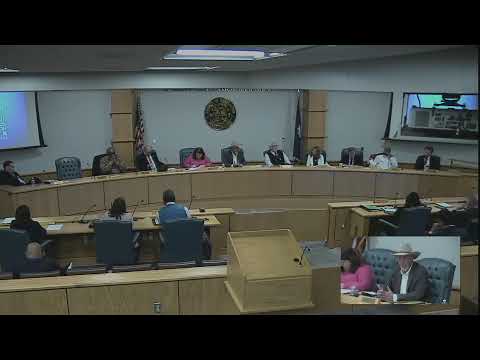
Charleston County council approves Homeland Security grant application after public push for written assurances on ICE
Loading...
Summary
After two hours of public comment and council debate about whether state-administered homeland-security funds could be used to support immigration enforcement, Charleston County Council approved its committee recommendation to proceed with the 2026 State Homeland Security Grant Program application while requesting written assurances about the grant's scope.
Charleston County Council voted on Jan. 27 to move forward with applying for the 2026 State Homeland Security Grant Program after extended public comment and a staff briefing clarifying how the grant funds would be used.
Emergency Management Director Justin Pierce told the council that the funds come from FEMA through the South Carolina Law Enforcement Division (SLED) and are intended to support the county’s regional weapons-of-mass-destruction and HAZMAT team. “These funds are FEMA funds, and they are specifically to fund our regional weapons of mass destruction and hazmat team,” Pierce said, describing uses such as exercises, training, equipment and software subscriptions used to keep the equipment operational.
Multiple public speakers, including Dulce Lopez of the ACLU of South Carolina and immigration attorney Samuel Moore, urged caution and asked the council to add explicit written language barring use of the funds for immigration-enforcement activities. “Before approving this grant, please add a clear written language stating that Homeland Security Grant Program funds in Charleston County may not be used for immigration enforcement activities, including cooperation with ICE,” Lopez said during public comment.
Speakers cited the Department of Homeland Security’s FY2025 standard terms and conditions and raised concerns that federal grant conditions can require cooperation with federal immigration officials or participation in 287(g) agreements. Moore told the council that Part C9 of DHS’s standard terms requires recipients under some awards to agree to coordination and cooperation with DHS and immigration officials.
Council members questioned how those federal terms apply to Charleston County’s award. Pierce and staff clarified the flow of funds and the county’s historical grant amounts: SLED applies for and receives the state-level pot from FEMA and subawards to the county; Charleston County historically receives about $55,000, although the county sometimes requests up to $150,000. Council discussion emphasized that the funds distributed to Charleston County are reimbursed after the county incurs eligible expenses: when asked how the money is distributed, a staff member answered plainly, “It’s reimbursed.”
Council members also addressed the widely circulated claim that SLED must set aside 10% of its statewide allocation for border-security or enforcement. Pierce said the 10% discussion refers to SLED’s statewide allocation and does not impose a 10% ICE-enforcement requirement on the county’s $55,000 subaward. He added: “A 100% of these funds will go to our WMD and HAZMAT program, full stop.”
A motion to delay consideration for two weeks so the county could obtain a written assurance from SLED or FEMA failed. During the roll call on the deferral motion the transcript lists Moody, Sass, Honeycutt and Kobrovsky as voting nay; the motion did not carry. The committee recommendation to proceed with the application then passed by voice vote.
Council members said they supported the HAZMAT and WMD training and equipment needs but acknowledged the public’s desire for clearer documentation. Several members asked staff to request and file a written assurance from SLED or FEMA that the county’s subaward will be used only for the stated emergency-preparedness purposes.
Votes at a glance: the council passed a zoning amendment (Ordinance 12-02 as amended) on third reading with nine ayes; the motion to defer the HSGP decision failed; the committee recommendation to proceed with the 2026 HSGP application was approved; and later the council voted to remove two appointees from county boards for failure to take the oath and complete mandatory training.
The council adjourned after a period of closing remarks in which members reiterated the county’s reimbursement process and emphasized public safety needs; staff said they would pursue written assurances and make them available for public review.