Get Full Government Meeting Transcripts, Videos, & Alerts Forever!
Get email alerts on the Traffic Safety Stop Signs topic
No spam. Unsubscribe anytime.
After residents' petitions and safety testimony, Lodi council asks staff to return with resolution for all‑way stop at Oak and Crescent
Summary
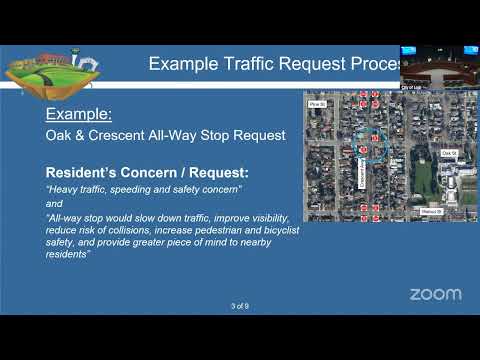
Following a Public Works presentation that Oak and Crescent do not meet MUTCD-based "warrants" (three collisions recorded; measured volumes 121 and 104 vehicles/hour), councilors heard residents describe near-misses and a 97-signature petition and directed staff to return in January with a resolution to consider installing an all‑way stop.
The Lodi City Council on Dec. 16 directed staff to return in January with a resolution proposing an all‑way stop at Oak and Crescent after a Public Works presentation and extensive resident testimony about speeding and near‑misses.
Public Works explained how the city evaluates requests for all‑way stops. Staff said the city receives about 150 traffic requests a year, typically acknowledges requests within 2–3 business days and completes studies in roughly 3–5 weeks depending on scope. The department applies the California Manual on Uniform Traffic Control Devices (Caltrans' modified MUTCD), the California Vehicle Code and the California Highway Design Manual when evaluating "warrants." The two primary warrant factors are collision history (a typical threshold cited was five "correctable" collisions within 12 months) and minimum traffic volumes (major street 300 vehicles/hour, minor street 200 vehicles/hour averaged over an 8‑hour period).
In the Oak and Crescent case, staff reported three reportable collisions going back to 2018 (two involved DUIs crashing into parked cars that staff said are not correctable by signage), and the highest eight‑hour period averages recorded were about 121 vehicles/hour on Oak and about 104 vehicles/hour on Crescent—both below the volume thresholds. Staff also said the intersection has been on the city's intersection study list since 1987, had larger stop signs and cross‑traffic signs added in 2002, and is currently ranked 111 of 314 intersections studied.
Public Works warned about the risks of installing stop signs that do not meet warrants: long‑term compliance can fall and mid‑block speeds can increase. Staff defined "correctable" collisions as right‑angle or T‑bone collisions that could be addressed by traffic controls and said that if an intersection meets the warrant for signage, a resolution would be brought to council for approval; traffic signals require a different, longer prioritization and funding path.
Residents spoke in support of an all‑way stop. Kim Combs said neighborhood volunteers had met and collected signatures and urged councilors to look beyond police‑reported collisions. Paul Schultz, a resident who lives inside the study circle, described multiple near‑misses and said the temporary speed trailer may have reduced counts while it was deployed. Mary Jane East said a car once nearly destroyed a yard wall and described frequent near collisions.
"Someone's gonna land in my front yard," Paul Schultz said, summarizing the urgency some neighbors expressed.
Council members said they understood both the technical warrant criteria and residents' safety concerns; several members expressed support for bringing back a resolution that would add an all‑way stop if council decides to proceed. Public Works estimated signage for two additional stop signs would cost roughly $1,000 and said staff would return with a resolution and any alternatives for a January meeting.
Next steps: staff will prepare a council communication and resolution for a future January meeting to consider installing an all‑way stop at Oak and Crescent, or to present alternatives and recommendations based on further analysis.