Get Full Government Meeting Transcripts, Videos, & Alerts Forever!
Get email alerts on the Howe Avenue topic
No spam. Unsubscribe anytime.
Commission recommends City Council adopt Connecting Howe Avenue safety and mobility plan
Summary
The Sacramento Active Transportation Commission voted unanimously to recommend City Council adopt the Connecting Howe Avenue safety and mobility plan, which proposes bike/pedestrian upgrades, landscaping, signalized ramp crossings and lane reductions in parts of the corridor. Staff said council consideration is expected next month.
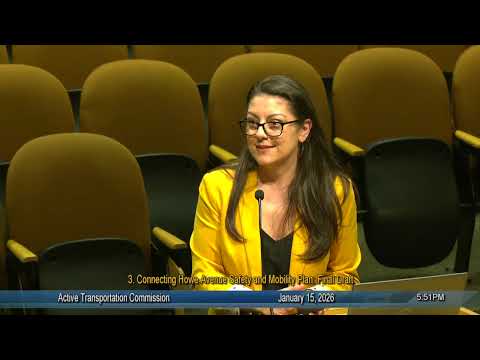
Charice Padilla, project manager for the Connecting Howe Avenue safety and mobility plan, asked the Active Transportation Commission to recommend City Council adopt the final draft plan after a multi-phase community engagement and data analysis process. The corridor, Padilla said, is one of the city’s Vision 0 top-10 corridors for fatal and severe-injury crashes and connects Sacramento State, nearby neighborhoods and businesses.
Padilla described the plan’s principal recommendations: a shared-use path on the east side of Howe Avenue; landscape buffers with shade trees and lighting; lowered posted speeds; filling sidewalk gaps; an enhanced crossing at University Park and a signalized crossing at US 50 ramp locations; removal of one travel lane in each direction between American River Drive and the American River Bridge; a cantilever structure on the east side of the American River/US 50 overpass; speed diverters north of University Avenue, optical speed bars where appropriate, and additional analysis of further lane reductions and intersection tightening at College Town Drive and La Riviera Drive. “The project was funded through a Caltrans sustainable transportation planning grant,” Padilla said, noting the plan was developed through three phases of community engagement.
A member of the public, Michael Bevins, testified that the plan was “fair” but incomplete and urged more aggressive lane reductions. “We need to break up this road,” Bevins said, proposing a split-lane approach that would separate through traffic from a slower street lane shared by turning vehicles and bicycles. Padilla and staff answered commissioner questions about implementation and quick-build options; Padilla said she did not bring detailed engineering cost or implementation timelines to the meeting and that such estimates would come later but referenced a roughly $40,000,000 figure as an approximate cost estimate.
After discussion, Vice Chair Isaac Gonzales moved and Commissioner Gibson seconded a motion to recommend City Council adopt the Connecting Howe Avenue safety and mobility plan. The clerk called the roll; the motion passed unanimously of those present.
The commission’s recommendation advances the plan to the City Council for consideration next month, where council will weigh final adoption and funding sequencing.