
Portland council adopts compromise amendment on $20.7 million rental-services fund after hours of testimony
Get AI-powered insights, summaries, and transcripts
Sign Up Free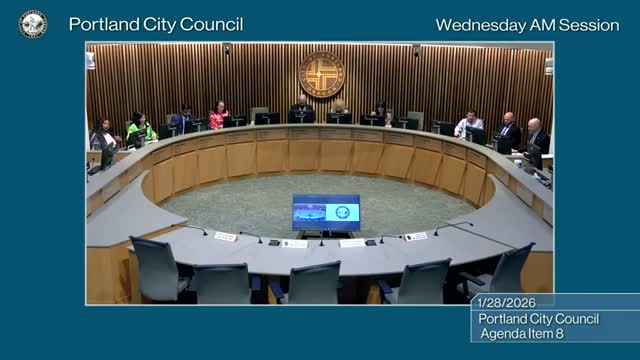
Summary
After hours of public testimony and debate, the Portland City Council adopted a compromise amendment reallocating approximately $20.7 million in rental-services office funds toward a mix of rent assistance, eviction prevention, housing development gap funding and pilot legal defense programs; other competing amendments failed and remaining proposals were left for a future meeting.
Councilors on Jan. 28 took up a contested resolution setting priorities for approximately $20,700,000 in unspent rental-services office funds, advancing a compromise amendment after extensive public testimony from tenant advocates, legal aid clinics, housing developers and neighborhood groups.
The sponsors, led by Councilor Avila (housing committee), said the revised package was designed to balance urgent renter supports with investments that stabilize and expand housing. Councilor Avila summarized the key elements as preserving $9,000,000 for rent assistance programs, adding gap funding for several affordable-housing projects, increasing down-payment assistance to $750,000, and expanding eviction-defense and a right-to-counsel pilot to $1.9 million.
The City Attorney’s Office advised councilors that the rental-services office is a fee-based fund (rental registration fees) and that expanded uses require clear findings and an ordinance tying the new uses to the fee’s authorized purpose. Adrienne Delcato told the dais: “The rental services office is a fee fund…all of those expanded uses would need findings and an ordinance to show how the use is connected to rental registration, and so, like, reasonably related.”
During public testimony, tenant-rights and eviction-defense organizations urged the council to prioritize immediate rent assistance and courthouse-based legal representation. Emily Comey of the Commons Law Center and multiple CLEAR Clinic speakers described courthouse clinic models that provide limited-scope representation at first appearance and reported high rates of tenants retaining housing after intervention. As Commons Law Center’s testimony summarized: the clinic’s model “meets most of our clients on the morning of their first appearance,” and counselors said that representation has led to measurable reductions in default and eviction judgments.
Developers and business groups urged a different balance. Representatives for the Broadway Corridor, Williams & Russell and other projects asked for gap financing to complete capital stacks and argued that targeted development funding could increase housing supply. Councilors debating the tradeoffs discussed options including direct rent buy-downs of existing affordable units, one-time down-payment assistance, and conditional gap funding that reverts to rent assistance if state matches are not secured.
Council action and next steps
- The council voted to adopt the Avila/Avalos/Dunphy/Smith compromise amendment (reported roll call: 8 yes, 4 no). That amendment redistributed funds across rent assistance, eviction prevention services, specific project gap funding and homeownership supports. - A competing Zimmerman amendment failed on a 6-6 tie vote. - Councilor Green moved an additional amendment (Green 1) to redirect certain project-specific gap funds into a larger portfolio-stabilization/rent-buydown program; that amendment was introduced and seconded but was not decided before the meeting adjourned. Council President Dunphy said the item will continue at a future meeting so councilors can finalize ordinance language and technical findings required by legal counsel.
Why it matters
The money comes from a rental-registration fee and was established for housing-related services. How council balances immediate eviction prevention and rent assistance with one-time investments to lower long-term rents or complete housing projects will shape near-term relief for renters and the longer-term affordability of Portland’s housing stock. Councilors repeatedly emphasized they were working within legal constraints and procurement requirements; the City Attorney’s Office said additional ordinances and findings would be necessary to broaden the fund’s uses.
What to watch next
Council asked the housing bureau and city attorneys to return with technical details: timelines for spending, procurement steps, which projects truly need gap funding now, and the legal findings necessary to appropriate fee funds for development projects. The council agreed to continue the discussion at a follow-up meeting next week.